
Introduction

To use baking soda for smoke smell, dust a generous, even layer of dry baking soda onto affected carpets, rugs, and upholstery, let it sit for 8 to 24 hours, then vacuum it up with a HEPA-filter vacuum. For airborne odors, pour baking soda about 1/4 inch deep into wide, shallow trays and place them near smoky soft furnishings or return vents. This works because baking soda chemically neutralizes acidic smoke residues rather than merely masking them.
Cigarette smoke is notorious for its ability to overstay its welcome. Long after the offending cigarette has been extinguished, the acrid, stale scent lingers in living rooms, bedrooms, and vehicle interiors. Studies show that between 80% and 90% of nicotine and related smoke compounds quickly adsorb onto indoor surfaces rather than staying suspended in the air.
These deposited particles create what scientists call "thirdhand smoke"—a persistent, chemical residue that coats drywall, seeps into carpet pads, and binds tightly to upholstery fibers. In fact, research tracking indoor contaminants found that thirdhand smoke residue was present in 100% of tested smoker and non-smoker apartments alike. This contamination is not just an unpleasant nuisance; smoking inside a home can slash its resale value by up to 29 percent.
Simply opening a window will not solve the issue. In controlled house studies, opening every window and door reduced airborne volatile organic compounds (VOCs) by 74% during active ventilation. However, within three hours of closing the house back up, VOC levels rebounded almost completely because the smoke compounds stored in indoor materials off-gassed straight back into the room.
To genuinely clear the air, you have to treat the surfaces where the odors are anchored. That is where ordinary sodium bicarbonate comes in. Using baking soda for smoke smell remediation provides an accessible, non-toxic, and scientifically sound way to neutralize these stubborn residues at the molecular level.
The Science: How Baking Soda for Smoke Smell Neutralizes Odors
Most commercial air fresheners rely on synthetic fragrances or cyclodextrins to temporarily mask smells or encapsulate airborne droplets. While this might give you a temporary burst of artificial lavender, it leaves the actual smoke particles intact. Baking soda works differently because it relies on chemical neutralization.
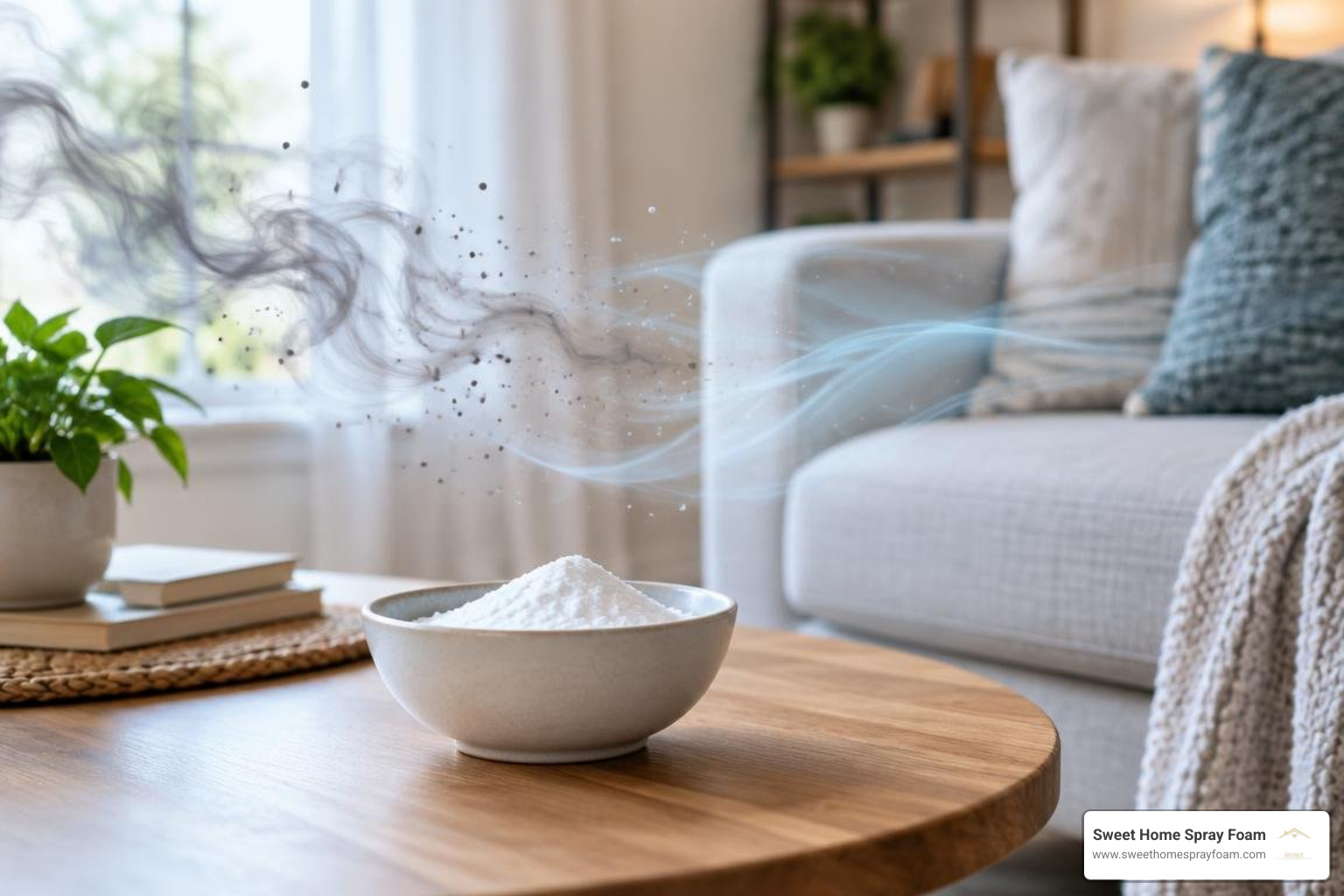
Understanding the chemical neutralization of household odors comes down to fundamental acid-base chemistry. Smoke from burning tobacco or organic matter contains hundreds of acidic and basic volatile organic compounds, including butyric acid, isovaleric acid, acetic acid, and basic amine complexes. Sodium bicarbonate ($NaHCO_3$) is an amphoteric compound, meaning it can act as either an acid or a base depending on what it encounters.
When baking soda meets acidic smoke molecules, it acts as a mild base, exchanging ions to turn those pungent, volatile compounds into solid, odorless sodium salts, trace water vapor, and carbon dioxide. Because these new salts are non-volatile, they cannot evaporate into the air to trigger your olfactory receptors.
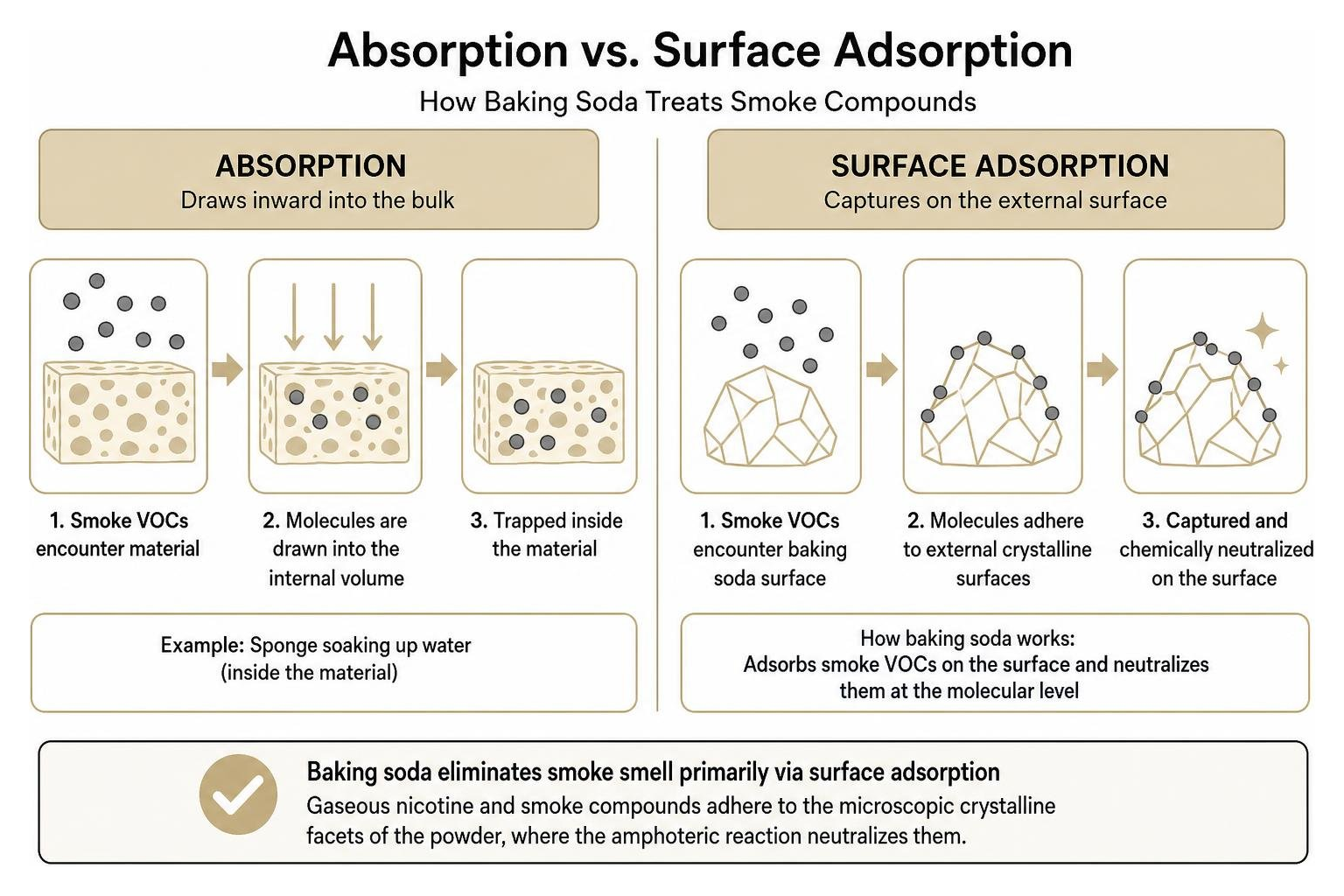
There is also a key physical distinction between absorption and adsorption:
- Absorption occurs when a liquid or gas is drawn into the internal bulk volume of a material (like a sponge soaking up water).
- Adsorption happens when gas molecules adhere specifically to the external and crystalline surfaces of a solid.
Baking soda eliminates smoke smell primarily via adsorption combined with chemical neutralization. Gaseous nicotine and airborne soot particles adhere to the microscopic crystalline facets of the powder, where the amphoteric reaction permanently neutralizes them.
Chemical Adsorption and the Amphoteric Reaction
Because smoke leaves an oily, acidic film—often rich in tar and nicotine—the pH buffering capacity of baking soda is essential. As the powder sits in direct contact with a contaminated fabric, it pulls acidic tar residues out of the fiber matrix.
The crystalline structure provides millions of microscopic bonding sites. Once an acidic VOC bonds to the sodium bicarbonate crystal, the neutralization reaction occurs, converting the volatile compound into a stable, non-aromatic salt. This reaction requires dwell time; the powder needs several hours of direct contact to ensure maximum molecular exchange across the entire surface area.
The Shallow Tray Technique for Maximum Surface Area
One of the most common household mistakes is setting a small, opened cardboard box of baking soda in the corner of a smoky room. In physics and chemistry, this is known as the "surface area paradox." The opening of a standard box exposes only about 4 to 6 square inches of powder to the air, leaving 95% of the crystals trapped beneath the surface where they cannot interact with airborne VOCs.
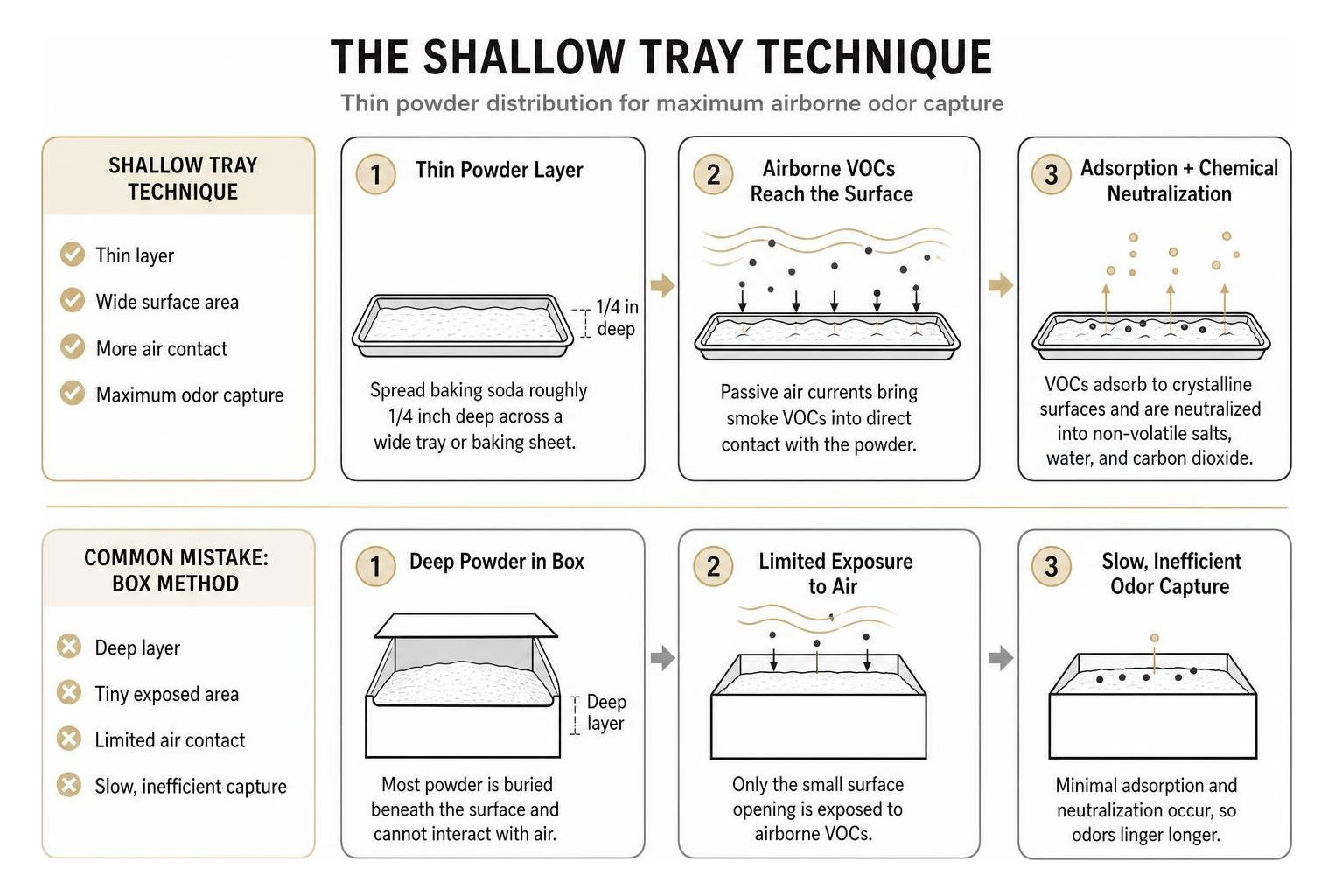
To overcome this limitation, use the shallow tray technique for odor absorption. By pouring baking soda roughly 1/4 inch deep across wide baking sheets, shallow trays, or wide-rimmed pie pans, you expand the exposed reactive surface area by several hundred percent.
Place these trays in areas with passive air currents—such as atop kitchen cabinets, near return vents, or beside smoky soft furnishings. The circulating air brings airborne VOCs into direct contact with the broad expanse of powder, dramatically speeding up passive odor capture.
Step-by-Step Guide: How to Apply Baking Soda to Different Surfaces
To get the most out of baking soda, you must apply it correctly according to the surface you are treating. A systematic approach ensures that you remove loose soot before applying the powder, allow sufficient contact time, and extract the spent powder safely.
Using Baking Soda for Smoke Smell on Carpets and Upholstery
Carpets and upholstered furniture act like giant air filters in your home, trapping airborne soot and oily smoke residues deep within their piles. A controlled house cleaning study demonstrated that systematically dusting, vacuuming, and cleaning soft and hard surfaces reduced airborne smoke VOCs by 39%, with levels remaining 38% lower 12 hours later.
To deep-clean your carpets and furniture using baking soda, follow these step-by-step room deodorizing methods:
- Pre-Vacuum with a HEPA Filter: Before applying any powder, vacuum the entire carpet or sofa using a vacuum equipped with a genuine HEPA filter. This lifts loose soot and ash particles rather than grinding them deeper into the fibers.
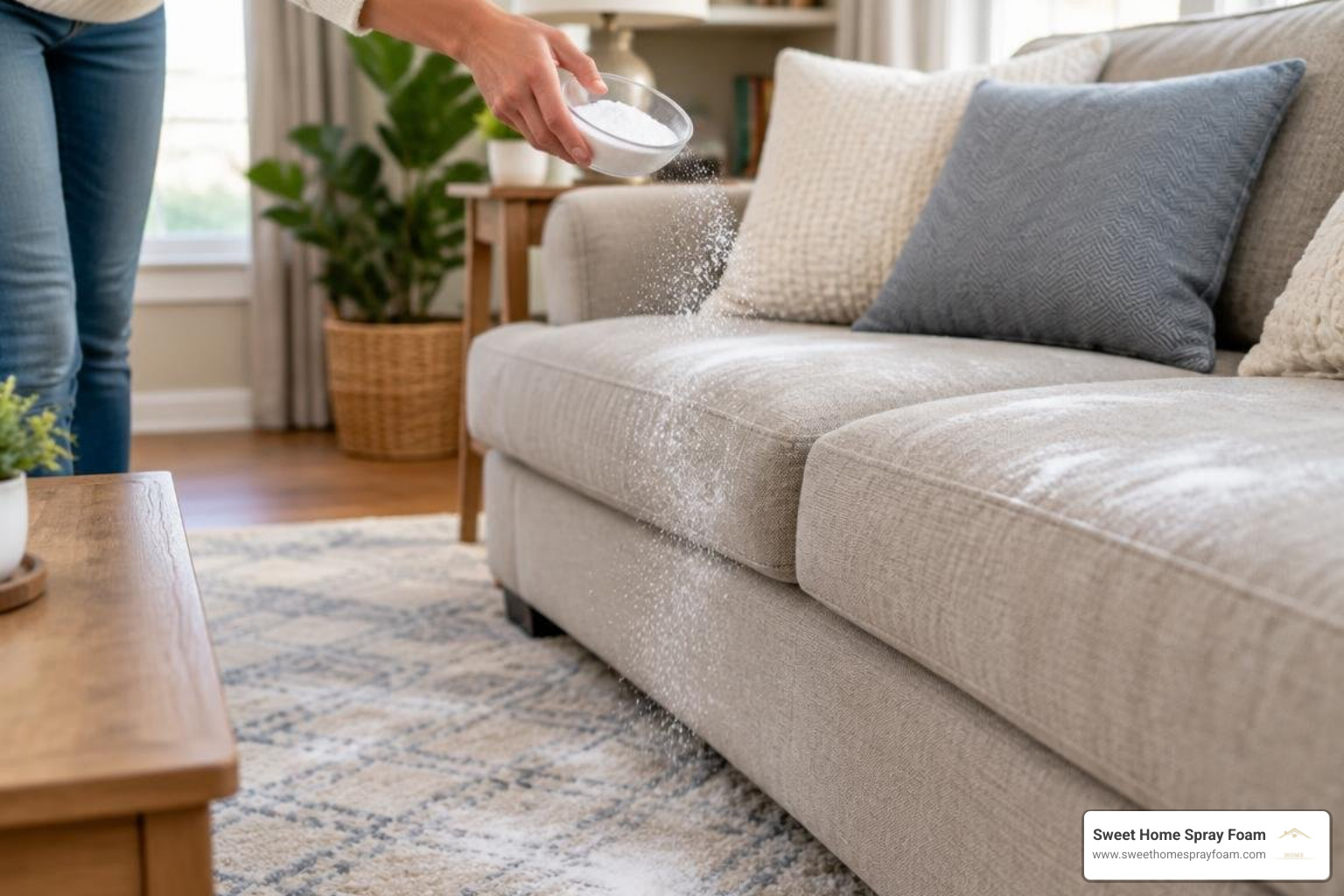
- Apply a Generous, Even Layer: Using a fine-mesh kitchen sifter or a shaker jar, dust a liberal layer of dry baking soda over the entire surface. You want an even, snowy appearance across the fabric.
- Work into the Pile: Gently brush the powder into the upper carpet fibers or sofa fabric using a dry, soft-bristle brush. Avoid aggressive scrubbing, which can fray delicate upholstery threads.
- Allow Sufficient Dwell Time: Let the baking soda sit undisturbed for a minimum of 8 hours, and ideally 24 hours for heavy cigarette odors.
- Vacuum Thoroughly: Vacuum the area slowly, making multiple overlapping passes to extract both the powder and the chemically bound smoke particles. Empty the vacuum canister or replace the bag immediately afterward so trapped odors do not blow back into the room.
Deodorizing Washable Fabrics and Clothing
Curtains, throw blankets, pillow covers, and garments readily absorb smoky oils. For washable textiles, you can combine direct adsorption with a water-based wash cycle:
- The Sealed Bag Pre-Treatment: For heavily permeated items, place the dry fabrics into a large plastic bag or sealed bin with 1 cup of baking soda. Shake the bag vigorously to distribute the powder, seal it, and allow it to sit for 24 to 48 hours to draw out volatile oils.
- The Washing Machine Cycle: Shake out the excess powder outdoors, then load the items into your washing machine. Add 1/2 cup to 1 cup of baking soda directly to the drum alongside your standard mild laundry detergent. Run the machine on a cold-water cycle to prevent residual smoke oils from setting into the weave under high heat.
- Ambient Air Drying: Hang the cleaned fabrics outside in a shaded, well-ventilated area. Sunlight and fresh outdoor airflow provide natural oxidation that helps clear any remaining trace scents.
Treating Non-Washable Rugs and Delicate Vintage Furniture
Antique chairs, velvet couches, and non-washable wool or silk rugs require extra care to prevent fiber damage:
- Always Spot Test First: Apply a teaspoon of baking soda to an inconspicuous spot (such as behind a furniture skirt or the underside of a rug corner). Leave it for 4 hours and vacuum it up to verify that no discoloration or texture changes occur.
- Use Suction-Only Attachments: When removing baking soda from delicate wool rugs or vintage upholstery, turn off the motorized rotating beater bar on your vacuum. Use a handheld upholstery tool or a straight suction nozzle to protect fragile antique fibers.
- The Dry Enclosure Method: For delicate vintage items that cannot tolerate direct powder contact, place the item inside a large, clean storage bin. Place shallow trays of baking soda on the bottom of the bin around the item, seal the lid, and let it rest for 3 to 5 days. The powder will passively capture airborne VOCs without touching the delicate material.
Comparing Baking Soda Against Other Smoke Odor Remedies
Baking soda is a versatile tool, but pairing or comparing it with other household agents can help you design the best strategy for your home.
| Odor Remedy | Mechanism of Action | Best Application | Relative Cost | Safe for Soft Fabrics? |
|---|---|---|---|---|
| Baking Soda | Amphoteric neutralization & crystalline adsorption | Carpets, upholstery, mattress tops, laundry pre-treatment | Very Low ($1–$3/box) | Yes (when dry) |
| White Vinegar | Acetic acid bonding & volatile mist neutralization | Hard surfaces, walls, ceiling wiping, laundry rinse cycle | Very Low ($2–$4/gal) | Yes (diluted mist) |
| Activated Charcoal | High-porosity physical adsorption (micropores) | Continuous passive room deodorizing, closets, vehicle cabs | Moderate ($10–$20/bag) | Yes (enclosed in breathable pouches) |
| Commercial Deodorizing Sprays | Fragrance masking & cyclodextrin encapsulation | Immediate, short-term spot freshening | Moderate to High ($6–$15/bottle) | Varies (may cause synthetic buildup) |
When dealing with tough smoke incidents, exploring multi-method burnt odor removal strategies allows you to match the right neutralizer to each specific surface.
Optimizing Baking Soda for Smoke Smell Alongside Vinegar and Charcoal
To get the best results, use these natural deodorizers in sequence rather than mixing them directly together:
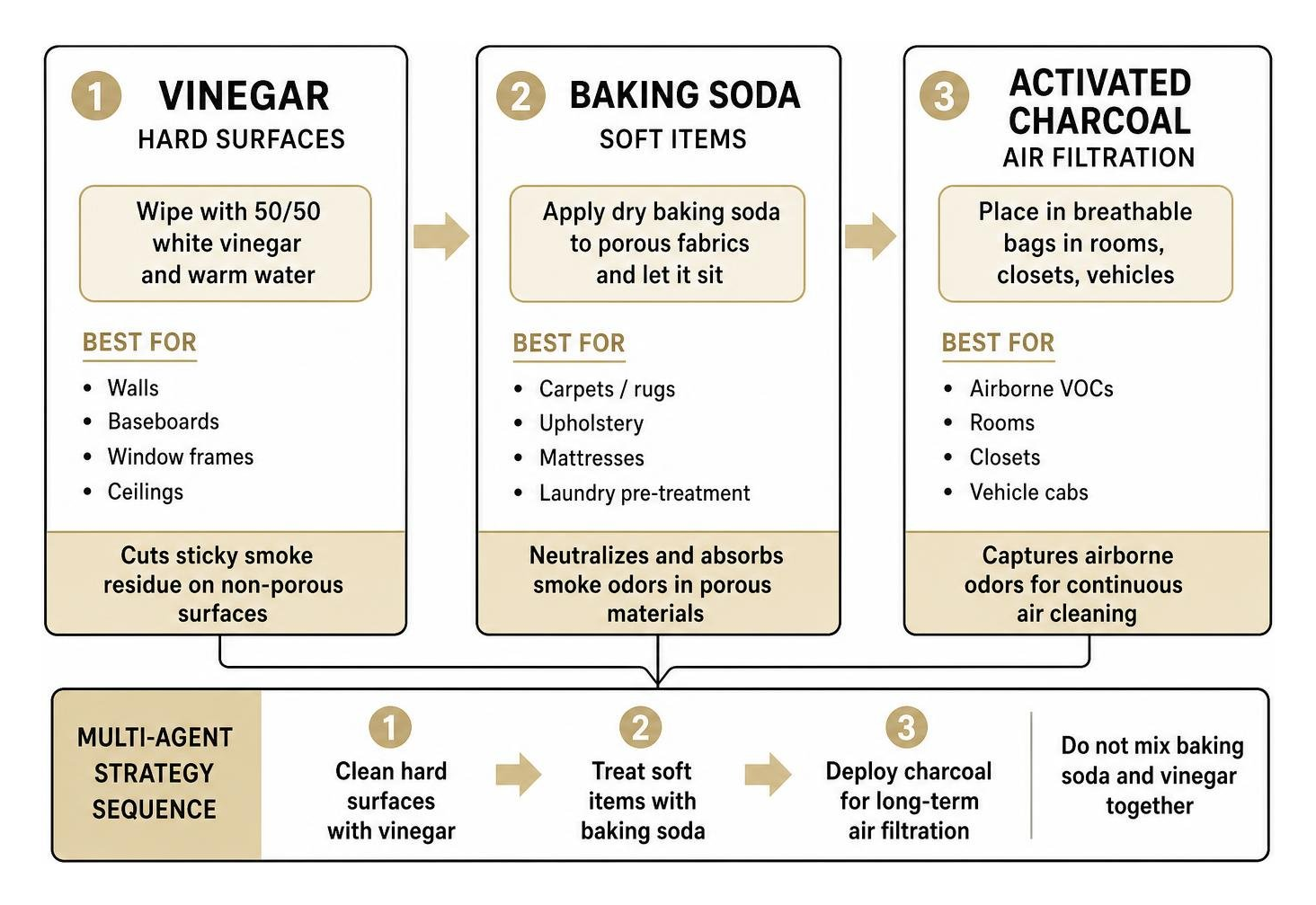
- Avoid the Fizz Trap: Never mix baking soda and vinegar together in a bowl expecting continuous odor removal. Their acid-base reaction instantly produces water, sodium acetate, and carbon dioxide gas, neutralizing the specific chemical properties that make each ingredient useful on its own.
- Wash Hard Surfaces with Vinegar: Wipe down smoke-filmed walls, baseboards, and window frames with a 50/50 mixture of distilled white vinegar and warm water. The acetic acid cuts through sticky nicotine tars on non-porous surfaces.
- Deodorize Soft Surfaces with Baking Soda: While the hard surfaces dry, apply dry baking soda to rugs, carpets, and sofas to treat the porous textiles.
- Deploy Activated Charcoal for Long-Term Air Cleaning: Place breathable linen bags of activated charcoal in corners and closets. Activated carbon features a vast network of microscopic internal pores that capture non-polar VOCs that baking soda might miss, providing continuous protection for weeks.
Critical Mistakes to Avoid and When Professional Help Is Needed
While pantry staples are powerful, using them incorrectly can waste time or even damage your home and cleaning equipment:
- Vacuuming Fine Powder with Standard Paper Filters: Baking soda particles are microscopic (around 50 to 70 microns). Standard vacuum bags or unsealed paper filters can allow this fine dust to pass straight through the exhaust, dispersing powder into your air or burning out the vacuum motor. Always use a vacuum equipped with a sealed HEPA filtration system.
- Applying Powder to Damp Surfaces: Never sprinkle baking soda onto damp carpet or upholstery. When exposed to moisture, the powder dissolves into a paste that dries into a crusty, chalky residue that is extremely difficult to vacuum out of dense fibers.
- Repainting Smoky Walls Too Soon: Slapping a coat of standard latex paint over smoke-stained drywall traps oily nicotine underneath. Over time, these chemicals will bleed through the fresh paint and continue off-gassing into your living space. Walls must be thoroughly washed, dried, and sealed with a dedicated, stain-blocking odor primer before repainting.
- Ignoring the HVAC System: If your furnace or air conditioner ran while smoke was present, the ductwork and filters are likely circulating smoke particles back into your rooms. Upgrade your HVAC setup to MERV 13-14 rated filters, which provide a 30.9% reduction in indoor PM2.5 levels compared to standard fiberglass filters.
When DIY Isn't Enough: Insulation and Building Envelope Considerations
If you have cleaned every surface, washed all textiles, and applied baking soda multiple times, yet a pungent cigarette or fire odor keeps returning on hot or humid days, the problem is likely hidden inside your home's structural building envelope.
Smoke does not just land on visible surfaces. Hot smoke creates positive pressure, driving volatile chemicals through tiny cracks around light fixtures, electrical outlets, and baseboards directly into your wall cavities, floor joists, and attic insulation. Traditional fiberglass and cellulose insulation act like open filters, absorbing smoke oils, soot, and moisture. Over time, changes in outdoor temperature and indoor humidity cause these trapped residues to off-gas back into the living space.
In these situations, standard cleaning will not reach the source. The affected fibrous insulation must be removed, the structural framing sanitized, and the building envelope properly sealed. High-performance spray foam insulation is especially effective here: it creates an airtight, continuous barrier that prevents air leakage, locks out outside humidity, and encapsulates building cavities so lingering structural odors cannot migrate into your living space. To understand how thermal boundaries and air barriers impact indoor air quality, take a look at our guide to proper insulation and air sealing.
Frequently Asked Questions About Smoke Odor Removal
How long does baking soda take to absorb smoke odor?
For light smoke exposure, baking soda needs a minimum of 8 hours to neutralize surface compounds. For heavy, thirdhand cigarette smoke or post-fire odor, leave the powder on dry carpets and upholstery for a full 24 to 48 hours. If the smell persists after the first vacuuming pass, repeat the application once or twice to draw out deeper residues.
Is baking soda safe for all types of fabric and carpet?
Baking soda is safe for the vast majority of synthetic carpets (such as nylon and polyester) and sturdy cotton upholstery. However, caution is required with high-end natural fibers. Do not apply dry powder directly to wet fabrics, untreated leather, suede, or delicate raw silks. Always test a small, hidden corner first, and use suction-only vacuum attachments on wool loops or vintage weaves to prevent pulling the fibers.
How often should room deodorizer trays be replaced?
In a room with noticeable smoke odor, shallow trays of baking soda reach their chemical saturation point within 24 to 48 hours. Once the exposed crystalline surfaces bond with ambient VOCs, they can no longer absorb additional odors. Discard and refresh the powder daily during the first week of intensive odor remediation, and replace monthly for routine maintenance.
Conclusion
Lingering cigarette smoke and thirdhand odor can make your home uncomfortable and reduce its property value. However, you do not need harsh chemical sprays or expensive masking agents to make meaningful progress. By understanding the science of chemical adsorption and using methods like the shallow tray technique, HEPA-assisted carpet treatments, and multi-agent cleaning, you can neutralize stubborn smoke odors safely and affordably.
For deep-seated structural odors, full restoration often requires looking beyond surface cleaning to address air leakage and contaminated attic or wall cavities. At Sweet Home Spray Foam, we specialize in helping homeowners throughout Virginia—including Richmond, Roanoke, Lynchburg, and Smith Mountain Lake—achieve cleaner indoor air, superior moisture control, and year-round energy efficiency. Explore our Sweet Home Spray Foam comprehensive home insulation and air sealing solutions to discover how high-performance building envelope upgrades can permanently protect your home's comfort and air quality.