Why Bonded Bead Cavity Wall Insulation Stops Damp in Its Tracks
What Is Bead Cavity Wall Insulation and How Does It Work?
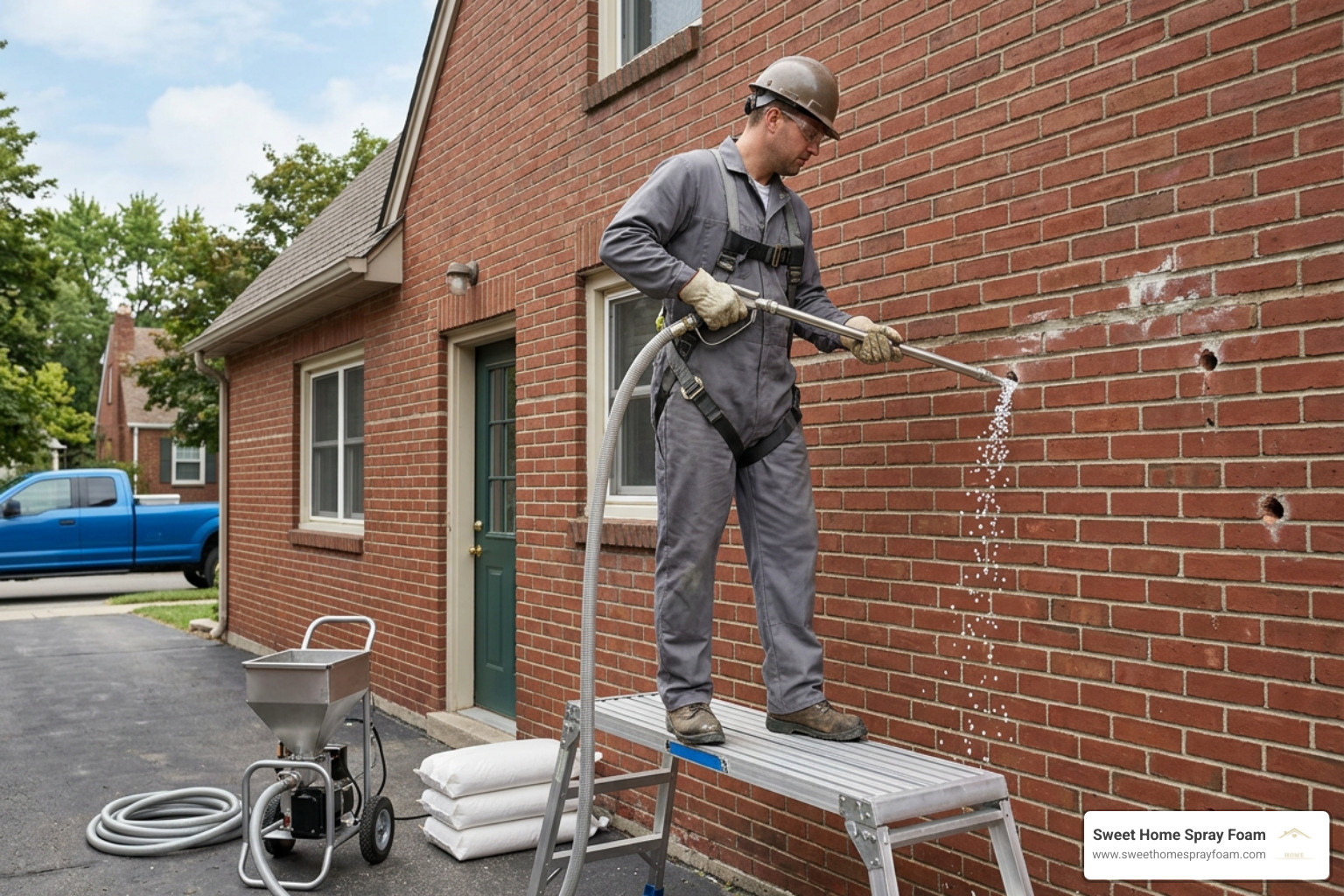
Bonded bead cavity wall insulation prevents dampness because closed-cell, hydrophobic expanded polystyrene (EPS) beads eliminate capillary moisture transfer while creating interstitial drainage channels for incidental rainwater to drain harmlessly away. Injected directly into the gap between exterior brick and interior masonry, these lightweight spheres are coated on-the-fly with an air-drying bonding adhesive, forming a cohesive, semi-rigid thermal matrix that resists water penetration and heat loss.
As detailed in The BPF Expanded Polystyrene Group guide on blown beads, modern EPS bead systems are engineered to achieve superior thermal performance. They feature a low thermal conductivity (lambda value) typically around 0.033 W/m·K. When injected into an interstitial wall space, the bonded spheres conform around wall ties, pipe sleeves, electrical conduits, and irregular masonry joints. This void-filling capability eliminates air pockets that cause thermal bridging.
Why Bead Cavity Wall Insulation Prevents Moisture and Damp
Homeowners frequently ask whether filling an empty cavity will invite dampness into their living spaces. In traditional masonry construction, the cavity exists specifically to prevent wind-driven rain from crossing from the wet exterior leaf to the dry interior leaf.
Bonded EPS beads protect against moisture bridging in two distinct ways:
- Zero Capillary Action: Expanded polystyrene is naturally hydrophobic and closed-cell. The material does not absorb water by capillary action (water absorption is exceptionally low, typically under 0.30 kg/m²). Liquid water simply cannot track across the beads horizontally to reach your interior walls.
- Free Drainage Interstitial Spaces: Because the beads are spherical, when they touch, they leave microscopic, non-capillary voids between them. Any incidental rainwater that penetrates the outer brickwork trickles safely downward through these voids under gravity to the base of the wall, where weep holes allow it to escape outside.
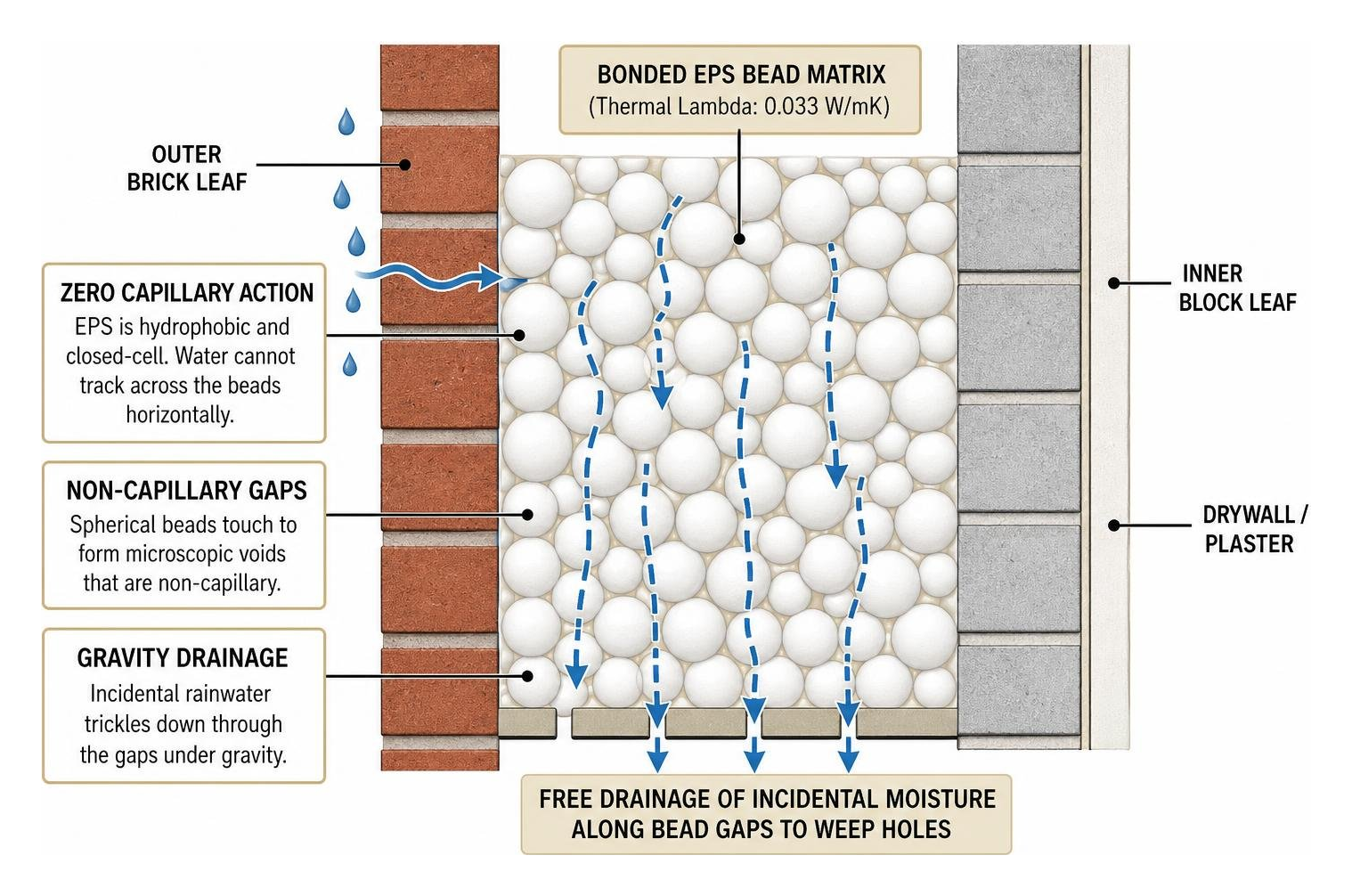
According to established BDA Agrément standards for cavity wall systems, bonded bead systems maintain the natural breathability of the wall assembly while preventing interstitial condensation. By raising the temperature of the internal wall surface, the system stops moist indoor air from condensing into unsightly mildew or black mold.
Performance Breakdown: Thermal Efficiency, Lifespan, and Costs
When selecting an insulation upgrade, building owners need clear data on thermal output, durability, and financial return. In 2026, energy standards demand lower U-values (the rate of heat transfer through a structure) than ever before.
EPS bead systems have an installed target density of approximately 12 kg/m³ (±2 kg/m³). When installed in standard 85 mm to 100 mm cavities, they can achieve exterior wall U-values of 0.27 W/m²K or better. Because uninsulated walls leak roughly a third of a home's conditioned air, retrofitting with bonded beads delivers up to a 30% reduction in heating and cooling energy loss.
| Performance Metric | Bonded EPS Beads | Closed-Cell Spray Foam | Mineral Wool Fiber |
|---|---|---|---|
| Thermal Conductivity ($\lambda$) | ~0.033 W/m·K | ~0.022 – 0.026 W/m·K | ~0.038 – 0.044 W/m·K |
| Installed Density | ~12 kg/m³ | ~32 – 40 kg/m³ | ~18 – 25 kg/m³ |
| Capillary Water Wicking | None (Hydrophobic) | None (Water Impermeable) | Moderate to High if wet |
| Settlement Risk | Very Low (Bonded) | Zero (Adhered) | Moderate over time |
| Air Sealing Quality | Moderate (Reduces convection) | Maximum (Complete Air Barrier) | Low |
| Environmental Rating | BRE Green Guide A+ | Low GWP Formulations | Variable |
From a sustainability standpoint, EPS beads achieve a BRE Green Guide A+ rating, are 100% recyclable at end-of-life, and feature a low carbon footprint during processing (around 3.25 kg CO₂ eq/kg). Because the binding agent cures into an inert adhesive web, the installation maintains its structural volume for the lifetime of the building without sagging or settling.
Comparing Bonded Beads to Spray Foam Solutions
While bonded beads excel at filling existing narrow masonry cavities without structural disruption, comparing traditional vs spray foam insulation reveals distinct advantages depending on your building assembly.
For open-cavity retrofits, new construction projects, or stud framing, wall spray foam insulation provides an unbroken, structural air barrier that expands to lock out uncontrolled air infiltration entirely. While bonded beads rely on existing wall membranes to manage convective air leakage, closed-cell spray foam functions simultaneously as an insulation material, vapor barrier, and continuous air seal.
How Contractors Install Bonded Beads in Existing and New Walls
The installation of blown bead insulation is clean, fast, and weather-independent. It does not require storing bulky insulation batts on-site or tearing down interior drywall.
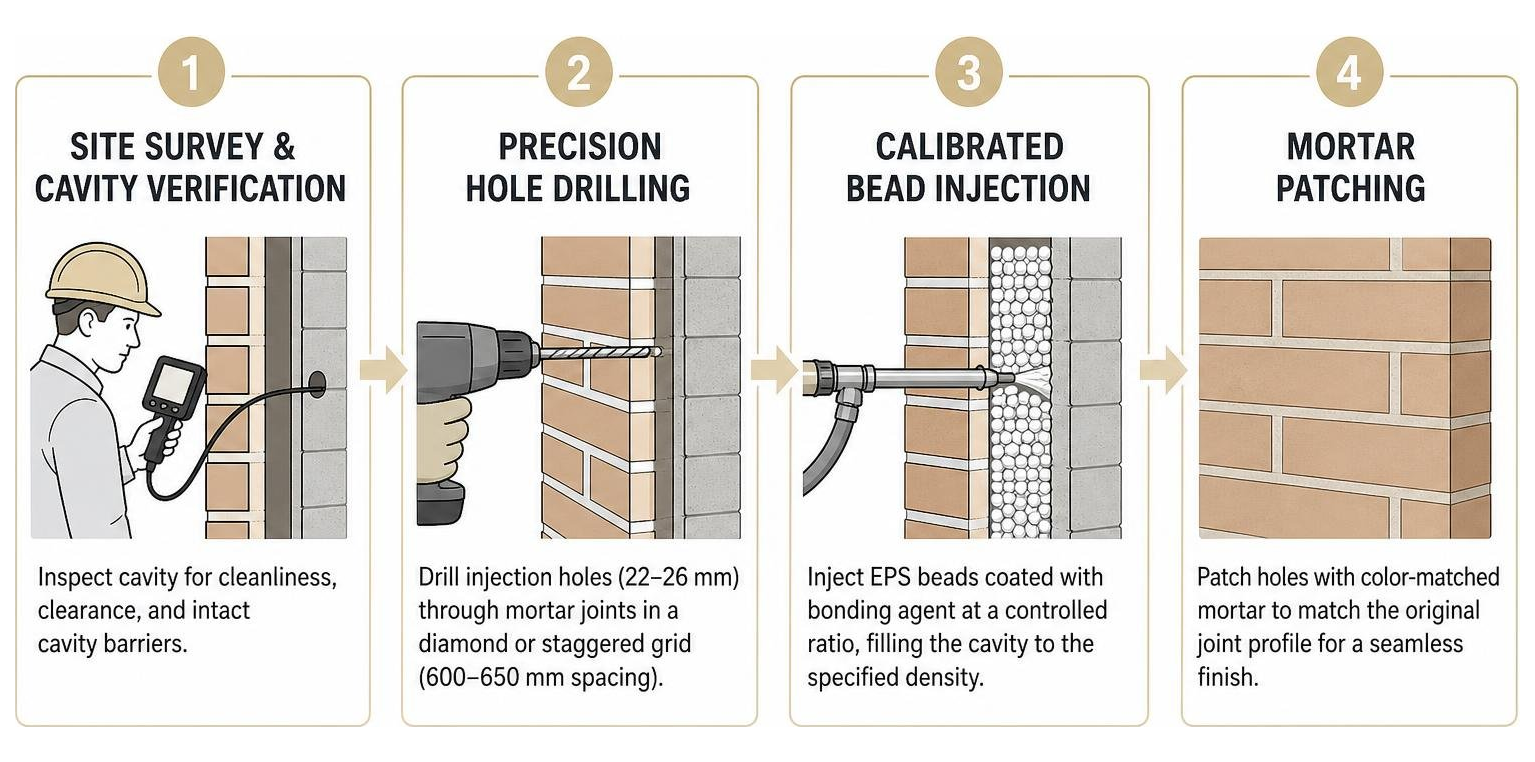
Before any work begins, certified technicians conduct a comprehensive borescope inspection. A tiny camera is inserted through the mortar joints into the cavity to verify that the gap is clean, dry, and unobstructed. The technician ensures that mortar bridges ("mortar snots" dropped by bricklayers) and debris will not block the flow of the beads. They also verify that non-combustible cavity barriers are intact around chimneys, flues, and fire separation zones.
Step-by-Step Installation of Bead Cavity Wall Insulation
- Site Survey & Cavity Verification: The team checks the property for structural soundness, external cracks, and clear weep vents. Cavity depth is measured to confirm clearance.
- Precision Hole Drilling: Small injection holes (typically 22 mm to 26 mm in diameter) are drilled through the external mortar joints according to a certified diamond or staggered grid pattern (usually spaced 600 mm to 650 mm apart).
- Calibrated Injection: Using a specialized injection lance powered by compressed air, the technician injects the EPS beads. The lance features an integrated nozzle that coats the beads with the liquid bonding agent at a precisely metered ratio as they exit the gun.
- Cavity Fill Verification: The material is injected systematically from the bottom courses upward until the cavity is packed to its specified 12 kg/m³ density.
- Mortar Repointing: The drilled holes are patched with color-matched mortar matching your original joint profile, rendering the entry points virtually invisible.
- Post-Installation Safety Checks: Installers verify that heating flues, air vents, combustion air supplies, and subfloor ventilation grills remain completely clear of stray insulation material.
Property Suitability and Limitations
Bonded bead systems are engineered primarily for standard masonry cavity walls constructed with brick, concrete block, or stone. They require a minimum cavity width of 40 mm (and preferably 50 mm or more for optimal thermal return).
However, bonded beads are not suitable for every structure:
- Hollow-Block Masonry: Unfilled concrete masonry units (cinder blocks) contain irregular internal webs that prevent uniform bead dispersal.
- Compromised Masonry: Walls with cracked render, spalling bricks, or missing mortar require masonry repairs before any cavity fill can be considered.
- Timber and Steel Framing: While certain engineered timber retrofits can accommodate bead systems, projects requiring new construction spray foam insulation benefit significantly more from spray-applied foams that bond directly to framing members and prevent moisture accumulation within stud bays.
If you are evaluating different construction assemblies, exploring comprehensive insulation education resources will help you select the exact formulation required for your regional climate and framing design.
Frequently Asked Questions About Cavity Wall Insulation
Can EPS beads cause dampness inside the home?
No, correctly installed bonded EPS beads will not cause dampness. Because the beads are manufactured from non-absorbent, closed-cell polystyrene, water cannot travel across them via capillary action. As long as exterior gutters, flashings, and mortar joints are in good repair, any driving rain that penetrates the outer brick drains harmlessly down through the interstitial bead spaces to the foundation weep holes.
How long does bonded bead insulation last?
Bonded bead cavity wall insulation lasts for the entire lifespan of the building. Expanded polystyrene does not rot, degrade, support fungal growth, or attract vermin. Because the individual beads are locked together with an aging-resistant bonding agent, the material will not settle, slump, or leave uninsulated gaps at the top of your walls over time.
What is the minimum cavity width required for bead injection?
Under standard Agrément certifications, the absolute minimum clear cavity width required for full-fill bead injection is 40 mm. For maximum thermal performance and ease of material flow around wall ties, a clear cavity width of 50 mm to 100 mm is preferred.
Conclusion

Maintaining a comfortable, energy-efficient home requires stopping convective heat loss without compromising your walls' natural ability to shed water. Bonded EPS bead cavity insulation delivers a proven thermal barrier that lowers utility bills, eliminates cold wall surfaces, and allows incidental moisture to drain away safely.
Whether your building requires high-performance cavity fill or complete air-barrier sealing with spray foam, choosing the right insulation strategy begins with an expert evaluation. Contact the team at Sweet Home Spray Foam today to schedule a comprehensive assessment of your home's thermal envelope and discover the most effective path to lasting energy savings and moisture protection.