
Why Concrete Surfaces Sink and Shift Over Time
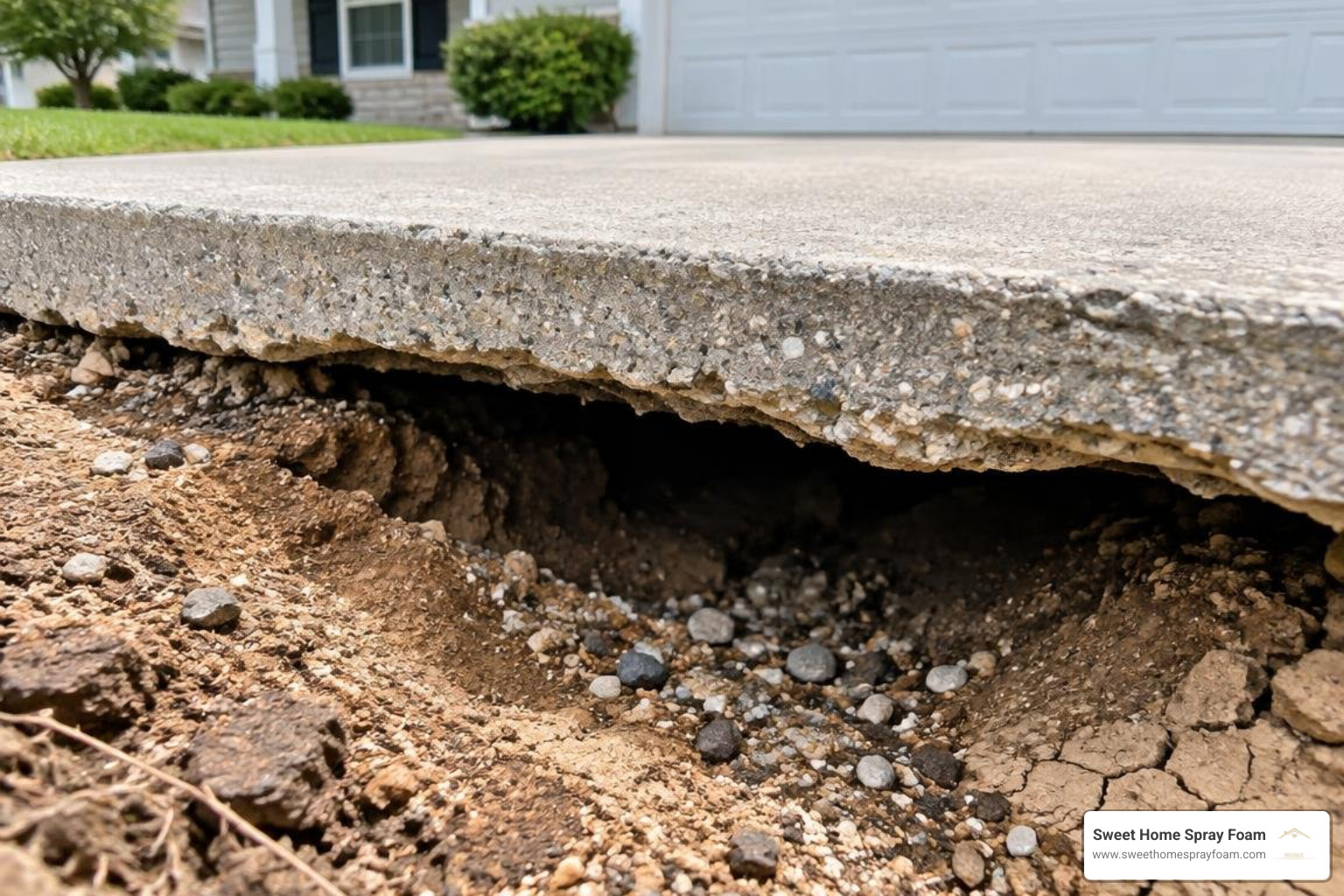
Uneven concrete slabs can be fixed affordably and effectively using high-density polyurethane foam injection to lift and stabilize settled slabs. This method fills voids beneath the concrete and raises the slab back to its original position without the cost or disruption of full replacement.
Concrete is remarkably strong under compression, but it relies entirely on the subgrade beneath it for structural support. Most residential slabs measure about four inches thick. While a four-inch slab easily supports standard vehicle and foot traffic when fully backed by solid ground, it possesses limited bending strength. When the underlying soil moves or washes away, empty pockets—known as voids—form beneath the concrete. Without uniform contact across its underside, the heavy slab eventually cracks, tilts, or sinks into the hollow space.
Several environmental and geological factors cause this subsurface instability:
- Subsurface Erosion and Poor Drainage: Rainwater from misdirected downspouts, roof valleys, or plumbing leaks flows along the edges of driveways and walkways. As the water travels beneath the concrete, it carries away loose sand and gravel, creating subterranean channels that leave the slab suspended in midair.
- Expansive Clay Soils: Regions throughout Virginia, including areas around Richmond, Roanoke, and Lynchburg, frequently feature soil rich in clay. Expansive soils swell significantly when wet and shrink drastically during dry summer months. This cyclical movement causes the slab to rise and fall repeatedly until the subgrade settles unevenly.
- Improper Soil Compaction: When homes, driveways, and patios are originally constructed, contractors must excavate and backfill soil around foundation walls and utility trenches. If this backfill is not mechanically compacted in shallow layers, the loose earth settles naturally over several years under the weight of the slab.
- Freeze-Thaw Cycles: Water trapped in voids beneath concrete expands by roughly 9% when it freezes. This creates frost heave, pushing sections of concrete upward. When the ground thaws in spring, the saturated soil softens and compresses under the slab’s weight, causing it to sink lower than its original position.
- Load Distribution Failure: Heavy vehicles parked near uncompacted edges concentrate immense point loads on unsupported sections, snapping the concrete along weak points and driving broken sections into underlying voids.
Understanding the mechanics of slab movement is essential for modern repairs. The underlying engineering principles date back decades. Large-scale lift slab construction was pioneered in 1952 at Trinity University in San Antonio, Texas, for the construction of Northup Hall. The technique proved that concrete slabs cast at ground level could be raised synchronously into place using hydraulic jacks. Today’s residential concrete leveling adapts similar load-distribution concepts, using modern materials to correct ground-level settlement quickly and safely.
Comparing Modern Solutions: Foam Injection vs. Other Repair Methods
When a walkway or patio drops, property owners generally choose between four primary options: expanding polyurethane foam injection, traditional mudjacking, mechanical bracket and pier systems, or complete slab demolition and replacement.
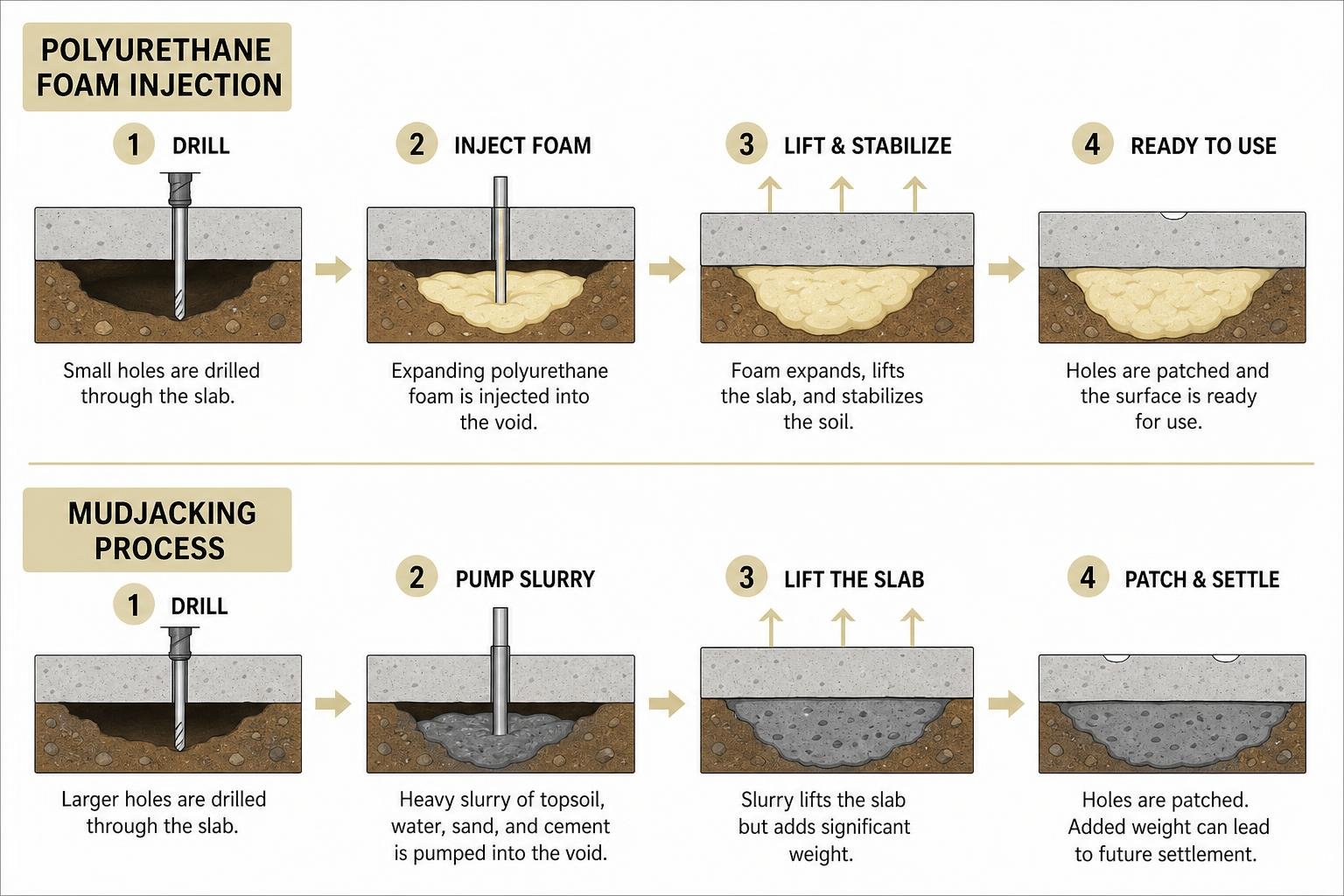
Historically, traditional mudjacking was the primary method for raising sunken slabs. It involves pumping a heavy slurry of topsoil, water, sand, and Portland cement under the concrete. While it can elevate a settled section, the slurry adds tremendous weight—often 100 to 120 pounds per cubic foot—onto soil that has already proven incapable of supporting the original slab. Over time, that additional mass can accelerate further soil settlement.
Mechanical piering systems use driven steel pipes, heavy-duty brackets, and hydraulic rams to anchor deep into load-bearing strata. These systems are invaluable for structural foundation recovery, but they are often overkill for standard flatwork like sidewalks or patios.
Demolishing and repouring concrete is another option, but it requires noisy jackhammers, heavy equipment that damages lawns, high disposal fees, and several days of curing time before the surface can bear traffic.
Modern high-density expanding polymer injection has become the preferred solution for property owners working with experienced concrete leveling contractors. The following table outlines how these approaches compare:
| Feature / Metric | High-Density Polyurethane Foam | Traditional Mudjacking Slurry | Mechanical Pier / Bracket System | Full Slab Demolition & Replacement |
|---|---|---|---|---|
| Material Weight | 3 – 5 lbs per cubic foot | 100 – 120 lbs per cubic foot | Heavy steel hardware and grout | Equivalent to new slab (~145 lbs/cu ft) |
| Access Hole Size | Penny-sized (~5/8 inch) | Soda-can sized (1.5 – 2 inches) | Large cutouts (7+ inches) | Full excavation / removal |
| Cure & Usability Time | 15 to 30 minutes | 24 to 72 hours | Immediate upon bracket locking | 7 to 28 days for full strength |
| Moisture Resistance | Hydrophobic; will not wash away | Vulnerable to water washout | Highly durable steel/grout | Standard concrete permeability |
| Lawn & Site Disruption | Minimal; single hose run | Moderate; heavy pump trucks | Moderate; localized digging | Severe; heavy excavation equipment |
| Subgrade Load Added | Negligible | Extremely high | Transferred to bedrock/deep soil | High original weight reinstated |
How Professional Cement Slab Lifting Works

Modern concrete leveling relies on controlled chemical expansion. The material used is a two-component closed-cell polymer formulated specifically for geotechnical load-bearing applications.
When component A (an isocyanate) and component B (a specially formulated polyol resin blend) combine at the tip of an injection gun under high pressure, an exothermic chemical reaction begins instantly. The liquid mixture expands up to 16 times its original volume, transforming into a dense, rigid foam within seconds.
As the polymer expands beneath the sunken slab, it follows the path of least resistance. It flows into intricate voids, consolidates loose soil particles, displaces standing subterranean water, and densifies the underlying subgrade. Once the empty pockets are completely filled, the expanding foam exerts uniform upward hydraulic pressure against the bottom of the slab. This force gently lifts the concrete back toward its original position without creating localized stress points that could cause cracking.
Specialized hydraulic pumps meter the components in an exact 1:1 ratio by volume and maintain precise temperature and pressure profiles. Because the reaction occurs beneath the surface, crews rely on precision optical levels and laser measuring instruments to track elevation changes to within a fraction of an inch.
Step-by-Step Cement Slab Lifting with Polyurethane Foam
The entire repair follows an orderly, minimally invasive procedure designed to restore structural support while keeping the surrounding property intact:
- Site Inspection and Void Mapping: Technicians inspect the settled area to locate underground utilities, identify drainage issues, determine the thickness of the slab, and map where subgrade voids are concentrated.
- Precision Micro-Drilling: Using a masonry hammer drill, technicians create strategically placed 5/8-inch holes (about the diameter of a dime) across the sunken slab. Because these ports are so small, they do not compromise the structural integrity of the concrete.
- Port Installation and Hose Connection: Tapered mechanical injection ports are seated securely into the drilled holes. A high-pressure delivery hose connected to the mobile proportioning unit is latched onto the port.
- Controlled Polymer Injection: The technician injects calculated bursts of liquid polymer beneath the concrete. Within roughly 15 seconds, the material expands, filling deep voids and compacting the base soil before applying lifting force.
- Laser-Monitored Elevation: The crew monitors the slab's movement using high-precision laser receivers. By alternating injection points, the team raises the concrete gradually, ensuring an even lift across cold joints and relief cuts.
- Port Removal and Hole Patching: Once the slab reaches alignment with adjacent walkways, curbs, or garage thresholds, the mechanical ports are removed. The 5/8-inch drill holes are cleaned and sealed with a non-shrinking, color-matched cementitious grout that blends with the surrounding finish.
- Rapid Return to Service: Unlike wet concrete or mudjacking slurries, structural foam achieves roughly 90% of its full compressive strength in about 15 minutes and is fully cured within 30 minutes. Homeowners can walk and drive on the surface almost immediately.
Homeowners seeking this fast, clean repair process can explore professional concrete lifting foam services across their local communities.
Protecting Your Property and Structural Foundations
Sunken concrete is not just an aesthetic issue; unlevel slabs can compromise the structural health of your home. When a driveway, patio, or sidewalk tilts toward the house, it acts as a funnel, directing thousands of gallons of stormwater toward the foundation walls.
Water pooling against the foundation increases hydrostatic pressure on basement and crawl space walls, leading to interior leaks, mold growth, and soil softening beneath structural footings. In garage slabs and interior floors, severe settlement can cause interior drywall to crack, bind exterior doors, and pull framing away from sill plates.
In commercial and heavy structural settings, specialized mechanical assemblies and driven piers can also be paired with foam stabilization to support settling building components without extensive demolition.
For residential properties, addressing concrete slabs before they cause foundational shifting is the most cost-effective approach. Maintaining proper perimeter grading, extending downspouts at least five feet away from flatwork, and pairing these habits with structural concrete lifting for foundations protects your property value and prevents expensive basement repairs.
Cost and Longevity: Is Cement Slab Lifting Worth It?
When evaluating concrete repairs, property owners must weigh initial expenses against long-term performance. Full slab replacement often costs several thousand dollars when factoring in demolition, haul-away fees, disposal permits, new aggregate subbase, ready-mix delivery, and finish labor. On forum discussions like Quora, homeowners often report quotes of $2,000 to over $5,000 for complex porch lifts or total tear-outs.
Polyurethane foam lifting typically costs between 40% and 60% less than full slab replacement while delivering superior long-term soil stability. Here is why property owners consider it a smart investment:
- Avoids Replacement Expenses: Preserving structurally sound concrete eliminates the labor, material, and disposal costs of pouring brand-new slabs.
- Permanent Soil Void Stabilization: High-density closed-cell foam does not break down underground. It will not rot, dissolve in water, or wash away during heavy rainstorms, providing continuous support for decades.
- Eliminates Trip Hazard Liabilities: An uneven walkway drop of just an inch poses a serious tripping risk for guests, delivery drivers, and family members. Raising the slab restores a safe, code-compliant walking surface.
- Zero Landscaping Repair Costs: Heavy demolition equipment tears up flower beds, sod, and sprinkler lines. Polyurethane lifting operates via long, flexible hoses run from a service trailer parked in the street, keeping your yard pristine.
- Restores Property Value and Curb Appeal: Sunken driveways, uneven front steps, and cracked sidewalks give a home a neglected appearance. Leveling these surfaces immediately improves curb appeal and protects appraisal values.
Frequently Asked Questions About Concrete Leveling
Can sunken concrete slabs be repaired without removing the existing slab?
Yes. As long as the concrete slab is structurally sound and has not shattered into numerous small fragments, it can almost always be lifted back into place. Expanding polyurethane foam fills the subterranean voids caused by soil settlement or erosion, re-establishing solid contact beneath the slab and lifting it back to grade without damaging the existing concrete or surrounding landscape.
How long does polyurethane foam take to cure after lifting?
Polyurethane lifting foam reacts and expands within 15 to 30 seconds of injection. It reaches approximately 90% of its full structural load-bearing capacity in about 15 minutes. In most residential applications, the surface is ready for full pedestrian and vehicular traffic within 30 minutes after the crew finishes patching the drill holes.
Why is foam injection preferred over other slab repair methods?
High-density polyurethane is far lighter than mudjacking slurry (weighing roughly 3 to 5 pounds per cubic foot compared to over 100 pounds for cement grout), meaning it does not overload fragile subsoils. Additionally, the polymer is hydrophobic—meaning it repels water and will not wash away over time. The process requires only tiny 5/8-inch drill holes, leaves virtually no mess, and cures in minutes rather than days.
Conclusion
Uneven, sunken concrete slabs do not have to result in expensive demolition projects or hazardous walkways. By choosing modern, high-density polymer injection, you can eliminate dangerous trip hazards, redirect water away from your foundation, and restore the beauty of your driveways, sidewalks, and patios in a single afternoon.
At Sweet Home Spray Foam, we take pride in helping Virginia homeowners—from Richmond and Lynchburg to Roanoke and Smith Mountain Lake—stabilize their properties with honest, upfront pricing and prompt, reliable service. If settled concrete is creating pooling water or uneven steps on your property, schedule an expert concrete lifting inspection with our experienced team today to restore your surfaces quickly, cleanly, and affordably.