
What Is the Average Cost of Internal Wall Insulation per m2 in 2026?
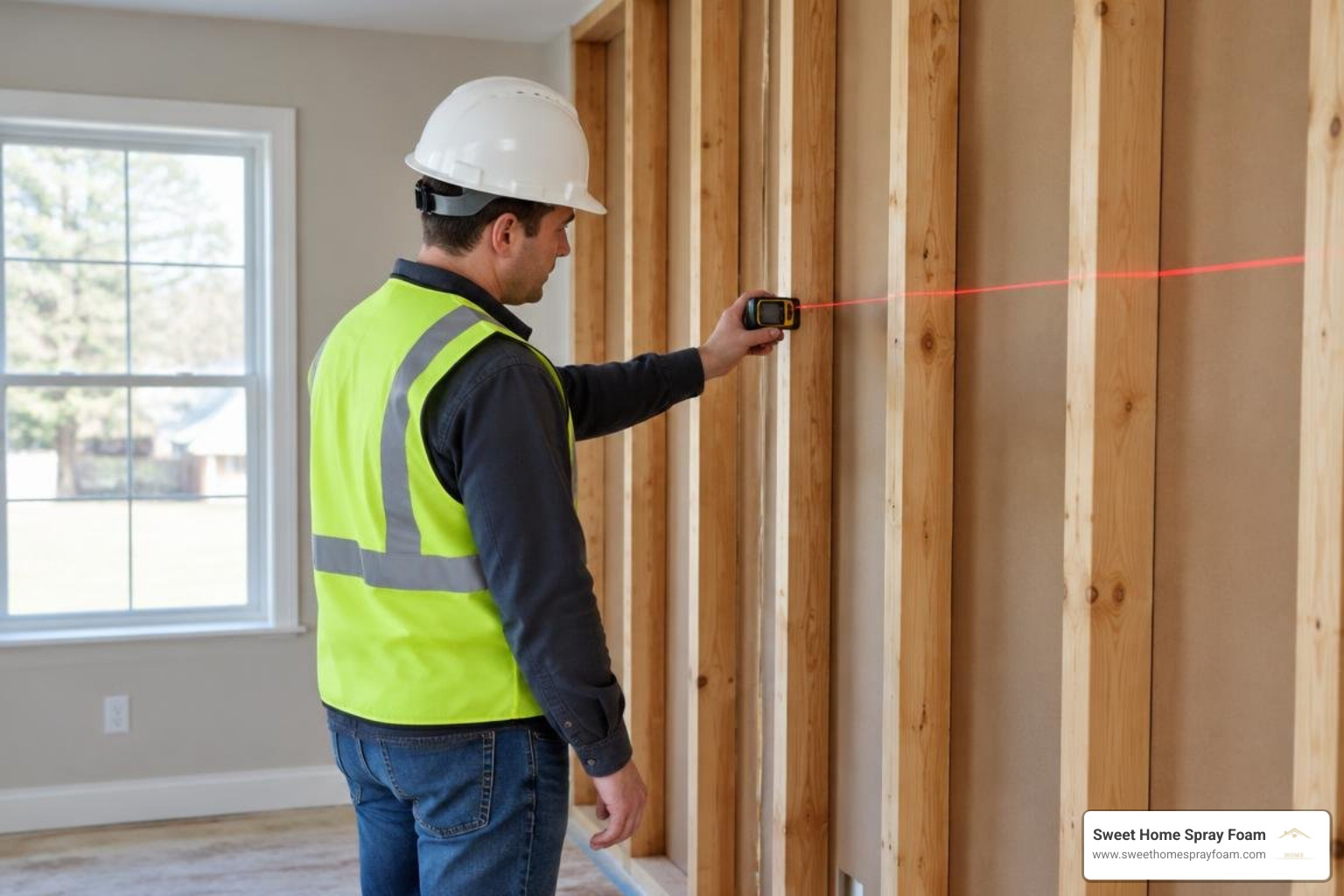
When budgeting for a thermal retrofit, estimating the baseline cost of internal wall insulation per m2 provides the most accurate foundation for your overall budget. As of 2026, most straightforward dry lining installations average between £60 and £100 per square metre. However, depending on surface complexity, damp remediation needs, and the chosen finish, the true range across the market extends from £40 to £120 per m² (or approximately €80 to €130 per m² for Irish retrofits).
Understanding how this breaks down requires looking at both sides of an installer's quote: labour and materials. On average, labour accounts for 55% to 65% of the total square-metre price, with materials, framing, and plaster skim making up the remaining 35% to 45%. Because solid walls account for roughly one-third of total heat loss in uninsulated properties, getting these calculations right is essential. For comprehensive market comparisons, reviewing solid wall insulation pricing benchmarks provides additional context across various building eras.
| Property Type | Typical External Wall Area (m²) | Average Cost Range (£60–£100/m²) | Broad Market Range (£40–£120/m²) |
|---|---|---|---|
| Small Flat / Apartment | 25 – 40 m² | £1,500 – £4,000 | £1,000 – £4,800 |
| Mid-Terrace House | 40 – 60 m² | £2,400 – £6,000 | £1,600 – £7,200 |
| Semi-Detached (3-Bed) | 70 – 100 m² | £4,200 – £10,000 | £2,800 – £12,000 |
| Detached Home | 110 – 160+ m² | £6,600 – £16,000 | £4,400 – £19,200 |
Material Breakdown: Cost of Internal Wall Insulation per m2 by Type
Different insulation materials provide drastically different levels of thermal resistance (R-value) for every millimetre of wall depth they occupy. When interior square footage is at a premium, thinner high-performance products often justify their higher material cost.
- Rigid PIR (Polyisocyanurate) Boards: The industry standard for dry lining. PIR delivers excellent thermal resistance at moderate thickness (typically 50mm–100mm bonded to plasterboard).
- Phenolic Foam: The thinnest high-efficiency rigid board option. Highly effective at low profiles, though carrying a premium material price tag.
- Mineral Wool (Rock or Glass Wool): Installed between timber or metal studwork. It provides outstanding acoustic dampening and non-combustible fire performance, but requires thicker profiles (100mm–140mm) to hit modern thermal standards.
- Natural Fibres (Sheep's Wool & Wood Fibre): Highly breathable and environmentally sustainable options, ideal for historic stone or lime-mortar brick substrates.
- High-Performance Closed-Cell Spray Foam: Applied directly into stud cavities or onto bare masonry with a separate plasterboard face. Spray foam forms an unbroken air barrier that eliminates draughts, bridges irregular wall profiles seamlessly, and seals perimeter air leaks without requiring bulky layers.
Exploring high-performance interior wall insulation methods helps clarify which material best balances thermal performance with room space constraints.
| Insulation Material | Average Material Cost (per m²) | Typical Installed Thickness | Average Installed Cost (per m²) | Thermal Performance (Lambda λ) |
|---|---|---|---|---|
| Expanded Polystyrene (EPS) | £8 – £14 | 80 – 120 mm | £45 – £65 | ~0.038 W/mK |
| Standard Mineral Wool (in studs) | £10 – £18 | 90 – 140 mm | £50 – £75 | ~0.035–0.040 W/mK |
| Rigid PIR Insulated Plasterboard | £18 – £32 | 50 – 100 mm | £65 – £95 | ~0.022 W/mK |
| Phenolic Foam Boards | £28 – £45 | 40 – 80 mm | £80 – £120 | ~0.018 W/mK |
| Natural Sheep / Wood Fibre | £22 – £40 | 80 – 120 mm | £75 – £115 | ~0.038–0.042 W/mK |
Estimating Property Totals from the Cost of Internal Wall Insulation per m2
To establish a realistic budget, calculate the net wall area by measuring each exterior-facing wall and subtracting the area of window and door openings. However, windows do not necessarily reduce your overall invoice proportionally; the labour required to insulate, bead, tape, and plaster window reveals often offsets the savings from reduced board area.
Homeowners frequently choose to stage installations room-by-room during broader interior renovations to manage costs and household disruption. For those evaluating budgeting strategies across different systems, our insulation cost estimation resources outline how square-metre pricing scales with project scope.
Hidden Variables and Ancillary Expenses That Drive Project Pricing
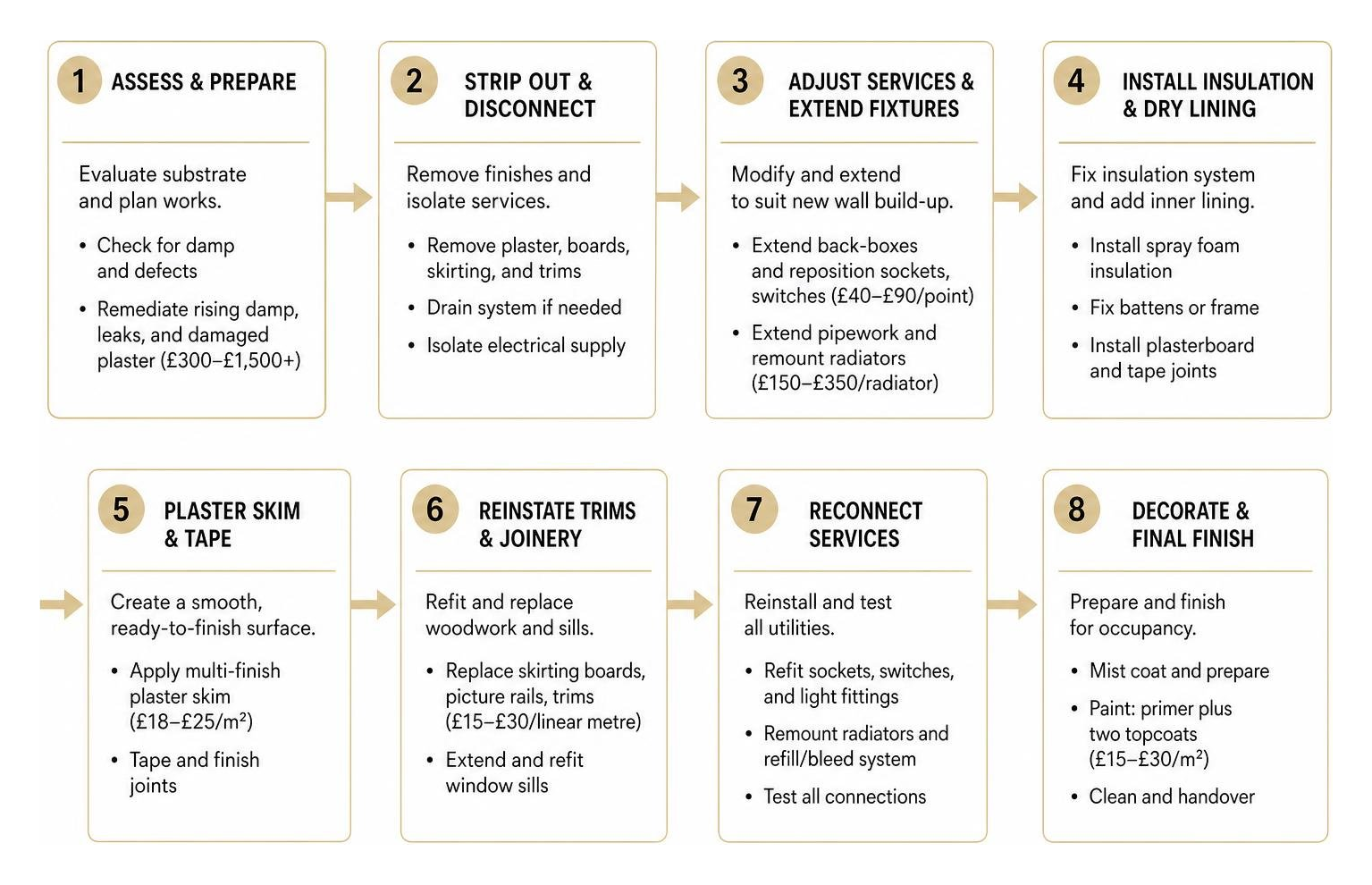
The cost of the insulation layer itself is only one part of the financial picture. Because internal insulation alters the inner perimeter of every exterior wall, existing fixtures, utility connections, and architectural trim must be stripped and reinstated.
Structural Prep, Utilities, and Redecoration Costs
Before any insulation is fixed to masonry, the underlying substrate must be evaluated. Applying insulation over damp masonry traps moisture within the wall structure, creating accelerated rot and mould growth.
Budgeting for trades beyond the insulation crew is essential:
- Substrate & Damp Remediation: Treating rising damp, fixing leaking rainwater goods, and removing damaged plaster (£300–£1,500+ depending on severity).
- Electrical Adjustments: Extending back-boxes, repositioning wall sockets, switches, and wiring runs (£40–£90 per point).
- Plumbing Modifications: Draining central heating, extending pipework, and remounting radiators onto extended brackets (£150–£350 per radiator).
- Carpentry & Architectural Trim: Removing and replacing skirting boards, picture rails, and extending window sills (£15–£30 per linear metre).
- Plaster Skimming & Redecoration: Applying a final multi-finish plaster skim (£18–£25/m²) followed by mist coating and painting (£15–£30/m²).
| Ancillary Task / Trade | Average Cost (Per Room) | Average Cost (Whole 3-Bed Semi) | Notes |
|---|---|---|---|
| Electrical Re-fixing & Extensions | £150 – £350 | £600 – £1,400 | Sockets, switches, wall lights |
| Radiator Removal & Pipe Extension | £150 – £300 | £600 – £1,200 | Includes refilling and bleeding system |
| Joinery (Skirting, Sills, Trim) | £180 – £400 | £700 – £1,600 | Timber replacement & refitting |
| Plaster Skim & Joint Taping | £250 – £500 | £1,200 – £2,200 | Prepares surface for paint |
| Final Painting & Redecoration | £300 – £700 | £1,500 – £3,000 | Primer, mist coat, two topcoats |
Labour Rates, Access, and Layout Complexity
A standard two-person trade crew charges between £250 and £450 per day. Simple, expansive rooms with uninterrupted rectangular walls progress quickly. Conversely, rooms with bay windows, chimney breasts, recessed alcoves, and integrated fitted cabinetry require extensive manual cutting and framing, substantially increasing labour hours per square metre.
Thermal Performance, Payback Periods, and Long-Term Energy Savings
Insulating exterior solid walls yields major gains in thermal comfort and efficiency, slashing heat loss through the building envelope by up to 60–70%.

U-Value Improvements and EPC Band Shifts
Uninsulated solid brick or stone walls built before 1920 typically have poor U-values ranging from 2.0 to 2.3 W/m²K. Modern building standards mandate that renovated thermal elements achieve a target U-value of 0.30 W/m²K or better.
Installing 80mm to 100mm of rigid PIR or high-performance closed-cell foam easily brings existing solid walls down to 0.28–0.30 W/m²K. This dramatic reduction in thermal transmittance often lifts a home's Energy Performance Certificate (EPC) by 1 to 2 full bands (e.g., from Band E or F up to Band C or B). Landlords and property owners can learn more through energy efficiency and retrofit planning guides to align with minimum energy efficiency standards (MEES).
Annual Utility Reductions and Break-Even Timelines
For a typical three-bedroom semi-detached solid-wall property, effective internal wall insulation yields annual heating bill savings of £250 to £600 (or €250 to €550 in Ireland), depending on heating fuel and boiler efficiency.
- Project Cost (Self-Funded, Full House): ~£6,000 – £10,000
- Annual Heating Bill Reduction: £300 – £500 (15% to 25% drop in heating fuel consumption)
- Unsubsidised Payback Period: Typically 12 to 22 years
- Subsidised Payback Period (with Grants): Instant to 5 years
While an unsubsidised payback of 15 years requires patience, the immediate increase in thermal comfort, elimination of cold radiant wall surfaces, and asset value appreciation make it a sound home upgrade.
Comparing Internal vs External Solid Wall Insulation Methods
When evaluating how to insulate solid masonry, property owners frequently weigh internal wall insulation (IWI) against external wall insulation (EWI). Both systems have distinct operational and financial trade-offs.
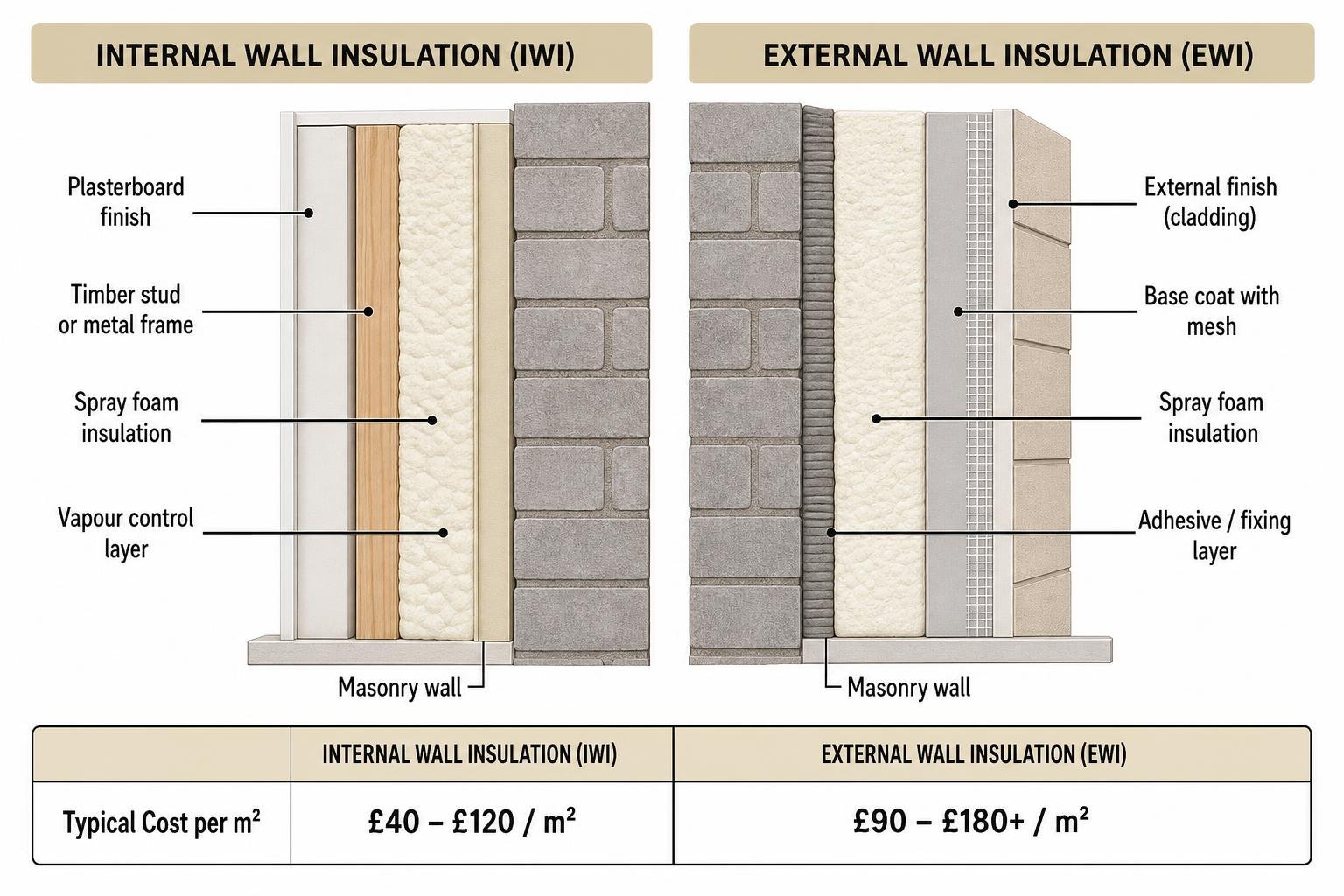
Weighing the merits of traditional dry lining vs modern insulation applications helps determine whether internal or external insulation aligns best with your architecture and budget.
| Metric / Consideration | Internal Wall Insulation (IWI) | External Wall Insulation (EWI) |
|---|---|---|
| Typical Cost per m² | £40 – £120 / m² | £90 – £180+ / m² |
| Whole-House Cost (3-Bed Semi) | £4,000 – £10,000 | £9,000 – £20,000 |
| Interior Space Loss | 50mm – 100mm per external wall | 0 mm (preserves all internal floor space) |
| Disruption Location | Internal (rooms cleared, trades inside) | External (scaffolding outside, low interior disruption) |
| Planning Permission | Rarely required (permitted development) | Often required in conservation zones / stone facades |
| Thermal Bridging Risk | Moderate (floor joists & partition walls) | Very low (continuous external thermal blanket) |
Usable Space Loss and Conservation Restrictions
The primary operational drawback of internal insulation is the loss of internal room dimensions. Adding 75mm of insulation board and plasterboard to an external wall reduces room depth by roughly 3 inches per wall, taking roughly 0.2 to 0.4 m² of usable floor area out of an average room.
However, for properties located within designated conservation zones, stone cottages, or homes with protected historic facades, external insulation is rarely permitted. In these circumstances, internal wall systems are the only viable retrofit path.
Moisture Control, Vapour Barriers, and Cold Bridging
Insulating a solid wall on the inside changes the wall's hygrothermal dynamics: the original exterior masonry leaf remains colder during winter months because indoor heat no longer passes through it.
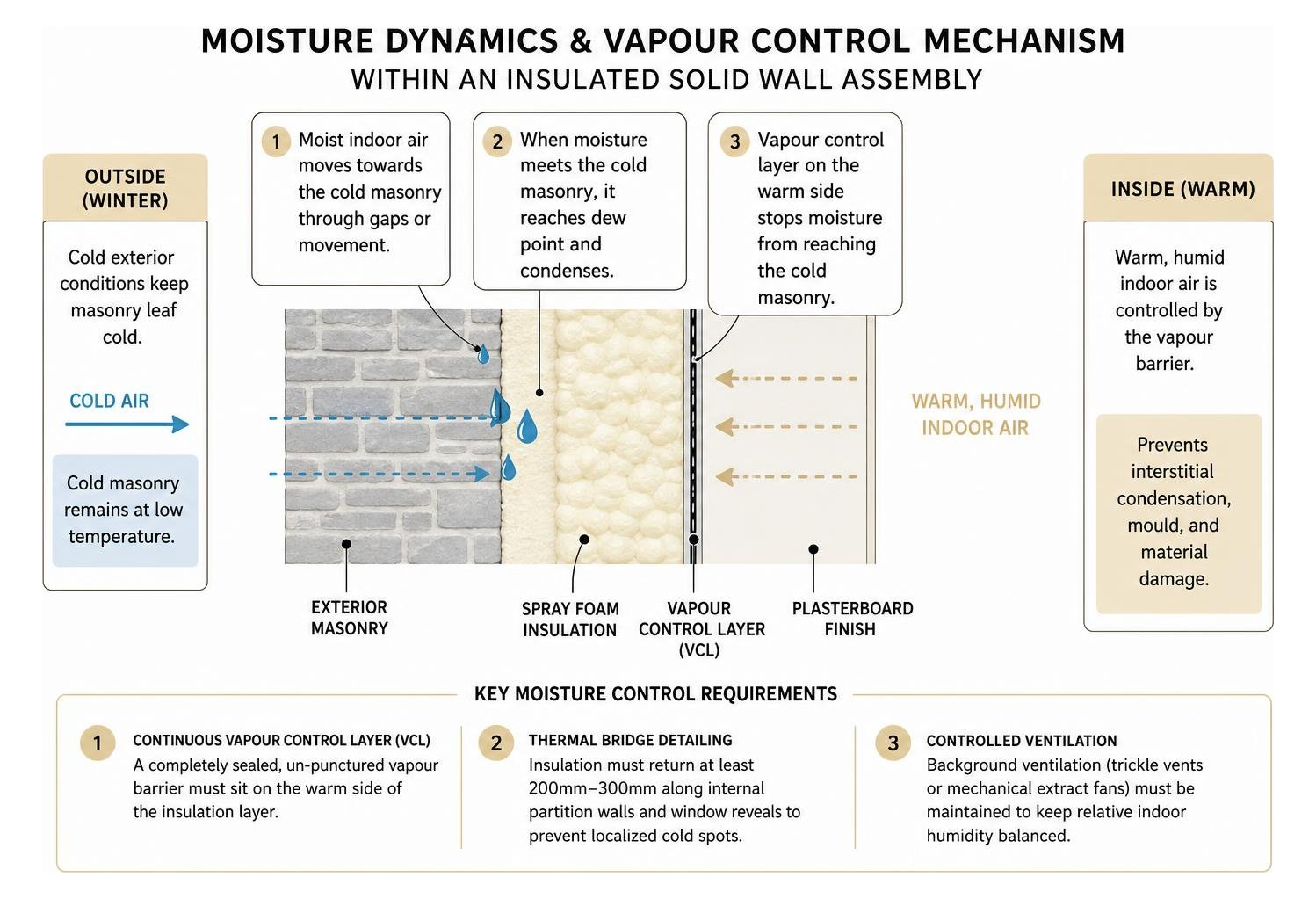
If humid indoor air penetrates behind the insulation, it meets that cold masonry face, reaching its dew point and condensing into liquid water (interstitial condensation). To prevent this:
- Continuous Vapour Control Layers (VCL): A completely sealed, un-punctured vapour barrier must sit on the warm side of the insulation layer.
- Thermal Bridge Detailing: Insulation must return at least 200mm–300mm along internal partition walls and window reveals to prevent localized cold spots where mould can form.
- Controlled Ventilation: Background ventilation, such as trickle vents or mechanical extract fans, must be maintained to keep relative indoor humidity balanced.
Homeowners retrofitting heritage stone or soft brick walls should review our breathable wall insulation guide to understand how vapour-permeable materials protect historic building fabrics.
Government Grants, Building Regulations, and Quality Standards
Subsidies and regulatory guidelines play an essential role in keeping installation standards high while softening the financial impact on homeowners.
Part L Compliance and Building Notice Approvals
Under UK Building Regulations (specifically Part L - Conservation of Fuel and Power), if you renovate more than 25% of an exterior wall's surface area, the entire wall element must be upgraded to satisfy modern thermal benchmarks (achieving an improved U-value of 0.30 W/m²K or better, where technically and functionally feasible).
Before beginning, a simple Building Notice should be submitted to your local council building control team or an approved private inspector. Upon job completion, they will issue a compliance certificate, an essential document required whenever you decide to sell or remortgage your property.
Incentive Schemes and Installer Standards
Government funding can dramatically lower the upfront barrier to solid wall insulation:
- Energy Company Obligation (ECO4): Grants running through 2026 that cover up to 100% of internal solid wall insulation costs for qualifying low-income households or properties with low EPC ratings (D, E, F, or G).
- Warm Homes / Local Authority Grants: Council-backed schemes delivering energy upgrades to off-gas or low-efficiency homes.
- SEAI Grants (Ireland): Subsidies administered by the Sustainable Energy Authority of Ireland providing fixed funding between €1,500 (apartments) and €4,500 (detached homes) toward internal insulation retrofits.
Always ensure your contractor is registered under TrustMark and holds PAS 2030 / PAS 2035 certification. These standards guarantee that your installer adheres to strict quality controls and can provide a 25-year insurance-backed guarantee. For more background on industry certifications, visit our insulation education hub.
Frequently Asked Questions About Solid Wall Insulation Costs
How much floor space do you lose with internal wall insulation?
Expect to lose between 50mm and 100mm (2 to 4 inches) of depth along each insulated exterior wall. For a standard 4m x 4m bedroom with two external walls, this equates to roughly 0.4 to 0.6 m² of floor space—comparable to the footprint of a small bedside table.
Does internal wall insulation cause damp or condensation issues?
Internal insulation does not inherently cause damp, but improper installation can. Because the masonry behind the insulation stays colder, warm, humid indoor air must be prevented from reaching the substrate. Installing an airtight vapour control layer (VCL) or utilizing closed-cell spray foam eliminates air gaps, preventing interstitial condensation and mould.
Is internal wall insulation worth the investment compared to external systems?
Yes, especially when budget, planning restrictions, or structural boundaries rule out external cladding. Internal insulation costs 40% to 50% less upfront than external systems, eliminates the need for expensive scaffolding, and preserves the exterior character of heritage homes while delivering similar heating bill savings.
Conclusion
Understanding the true cost of internal wall insulation per m2 involves balancing the base supply and fit rates (£60–£100/m²) against essential room preparation, electrical re-fixing, and final plaster finishing. While retrofitting interior solid walls requires thoughtful planning around room space and moisture management, the rewards—lower fuel bills, an improved EPC rating, and a warmer home—make it one of the most effective energy upgrades available.
Whether you are looking to insulate hard-to-treat solid walls or eliminate draughts, working with certified, experienced professionals ensures your investment performs flawlessly for decades. At Sweet Home Spray Foam, we take the guesswork out of home comfort with clear, upfront pricing, prompt service, and expert moisture control solutions across Richmond, Roanoke, Lynchburg, and Smith Mountain Lake. Contact our team today for a pressure-free property assessment and let us help you build a warmer, more efficient home.