The Most Affordable Spray Foam Insulation Kits Ranked
Types of Budget Spray Foam Kits: Cans vs. Two-Component Tanks
The most affordable spray foam insulation kits range from approximately $0.92 to $1.95 per board foot. For small DIY air sealing and patch jobs, multi-can options like the BEEST FullStop system (~$0.92 per board foot) and the ixirpro kit (~$0.96 per board foot) offer the lowest entry costs. For mid-size projects, high-yield dual-tank systems like the HF HandiFoam 600 (~$1.44 per board foot) and DuPont FROTH-PAK 630 (~$1.46 per board foot) provide the best coverage value.
When exploring budget-friendly insulation options, homeowners choose between two primary product formats: single-component polyurethane cans and two-component tank kits. Single-component cans rely on atmospheric humidity to cure. They expand slowly, making them well-suited for filling narrow voids, perimeter cracks, and plumbing penetrations. In contrast, two-component systems mix polymeric isocyanate (Side A) and a polyol resin blend (Side B) inside a specialized nozzle tip to create rapid expansion and build high thermal resistance.
When evaluating traditional vs spray foam insulation, closed-cell spray foam provides superior air-sealing and moisture barrier properties compared to standard fiberglass batts. However, coverage yield dictates which kit style delivers true value.
| Kit Name / Model | Format | Price (USD) | Stated Yield (Board Feet) | Est. Cost / Board Foot | Stated R-Value | Best For |
|---|---|---|---|---|---|---|
| ixirpro Spray Foam Kit (6-Pack) | Single-Component Can Gun System | $149.99 | Up to 156 bd ft (26 bd ft/can) | ~$0.96 | R-5.66 per inch | Targeted air sealing, small touch-ups, sill plates |
| BEEST FullStop System | Hybrid Multi-Can System (12 Cans) | $219.95 | ~240 bd ft | ~$0.92 | R-8.24 at 2" (R-4.12/in) | Small renovations, shed touch-ups, wall cavities |
| DuPont FROTH-PAK 200 | Two-Component Dual Tanks | $389.00 | 200 bd ft | ~$1.95 | R-6.2 per inch | Rim joists, crawl space band boards, small attics |
| HF HandiFoam 600 | Two-Component Dual Tanks | $863.99 (Sale) | 600 bd ft | ~$1.44 | ~R-6.0 to R-6.5 per inch | Mid-size garage walls, small crawl spaces, attic flats |
| DuPont FROTH-PAK 630 | Two-Component Dual Tanks | $919.00 | 630 bd ft | ~$1.46 | R-6.2 per inch | Basements, larger rim joist runs, bonus rooms |
| FROTH-PAK Low GWP 650 | Two-Component Dual Tanks (Eco-Blend) | $1,010.00 | 650 bd ft | ~$1.55 | R-6.8 per inch (R-14 total at 2") | Full cavity insulation, eco-conscious retrofits |
Top Can-Based Cheap Spray Foam Insulation Packs
For spot applications under 200 board feet, multi-pack can systems offer the lowest initial barrier to entry. Products like the ixirpro Spray Foam Kit come in 30 oz. (850g) canisters designed for use with reusable applicator guns. These guns allow precise trigger control, preventing the continuous discharge mess typical of disposable straw nozzles.
Can-based kits excel at sealing basement rim joists, electrical penetrations, and window framing gaps. Because each can represents an isolated quantity of foam, you only activate the exact volume needed for the job. Unused cans remain shelf-stable for months, eliminating the ticking clock associated with large pressurized cylinders.
High-Yield Cheap Spray Foam Insulation Tanks for Medium Projects
When square footage increases, can systems become tedious and cost-prohibitive. Two-component pressurized tanks—such as the DuPont FROTH-PAK 200, FROTH-PAK 630, or the HF HandiFoam 600—provide the spray volume needed for stud cavities and broad surfaces.
These setups include pre-pressurized tanks connected via chemical hoses to an applicator gun. High-yield tanks feature closed-cell chemistries that cure into rigid, high-density foam barriers. When tackling full stud cavities, installing proper wall spray foam insulation creates an airtight thermal envelope that simultaneously controls vapor drive. Kits meeting ASTM E84 Class A fire-test standards provide additional building code compliance for interior living spaces.
Best Cheap Spray Foam Insulation Kits Ranked by Cost and Value
Selecting the best budget kit involves balancing initial purchase price with raw chemical yield, thermal performance, and bundled equipment.
BEEST FullStop Insulation System (Best Overall Value for Small Jobs)
Retailing at $219.95 for 12 pressurized cans, this system yields approximately 240 board feet (at an effective cost of $0.92 per board foot). It achieves an R-value of 8.24 at a 2-inch thickness and includes a Pro X application gun, safety coveralls, gloves, goggles, and cleaner. Its hybrid design creates an open-cell core with a dense outer skin, making it accessible for beginners tackling sheds, small attic knee walls, or band boards.HF HandiFoam 600 ft. Insulation Kit (Best Value Tank Kit for Medium Areas)
Priced at $863.99 on sale (down from $1,079.99), this high-capacity kit delivers up to 600 board feet of closed-cell foam at roughly $1.44 per board foot. It includes pre-attached hoses and an ergonomic dispensing gun, providing substantial coverage for unfinished basement walls and subfloors without requiring dozens of individual cans.DuPont FROTH-PAK 200 Kit (Best Starter Dual-Tank System)
At $389.00 for 200 board feet ($1.95 per board foot), the FROTH-PAK 200 provides professional-grade, Class A fire-rated closed-cell foam yielding R-6.2 per inch. It is ideal for targeted sealing of attic floor joists and crawl space perimeters where high structural density and moisture resistance are critical.FROTH-PAK Low GWP 650 Kit (Best High-Performance Eco Formulation)
Priced at $1,010.00, this kit yields 650 board feet ($1.55 per board foot) with an R-value of R-6.8 per inch (R-14 at 2 inches). Utilizing a blowing agent that reduces global warming potential by over 99% without HFCs, it provides exceptional thermal performance for extensive attic spray foam insulation and rim-joist projects.ixirpro Spray Foam Kit (Best Budget Can Multi-Pack)
Priced at $149.99 for a 6-pack (covering up to 156 board feet), this kit offers closed-cell polyurethane foam rated at R-5.66. It serves as an economical choice for addressing isolated air leaks around ducting, exterior hose bibs, and sill plates.
Key Features Budget-Conscious DIYers Must Evaluate
When comparing kits, look beyond the sticker price:
- True Board-Foot Yield vs. Real-World Output: Manufacturer ratings assume laboratory conditions (75°F ambient and surface temperature). Cold tank temperatures can reduce chemical yield by 20% to 30%, increasing the effective cost per board foot.
- R-Value per Inch: Higher density closed-cell chemistries deliver R-6.0 to R-6.8 per inch, allowing you to achieve code-mandated thermal resistance in shallow 2x4 cavities. Open-cell and hybrid foams range from R-3.6 to R-4.2 per inch.
- Anti-Crossover Nozzles: High-grade kits use specialized nozzles that prevent the A and B chemicals from backing up into opposite hoses, protecting your lines from instantly curing shut during pauses.
- Included Accessories: Kits that bundle application guns, spare fan and cone nozzles, hose assemblies, and acetone cleaners save $40 to $80 in mandatory setup gear.
Shelf Life, Expiration, and Open-Tank Reusability
A major hidden risk of two-component kits is chemical expiration. Unopened tanks generally have a shelf life of 12 to 15 months from manufacture. Once the valves are opened, internal chemical exposure begins:
- The 30-Day Limit: Most manufacturers mandate using the entire tank contents within 30 days of opening. Beyond this window, moisture drives crystallization inside the Side A isocyanate valves, leading to clogs and off-ratio foam.
- Storage Temperature: Store tanks between 60°F and 80°F. If tanks freeze or overheat, the blowing agents degrade, resulting in spongy, uncured foam that fails to insulate.
- Mitigating Waste: If a project does not require an entire 600 board-foot kit, purchase smaller systems (like the FROTH-PAK 200 or can multi-packs) rather than stranding half-empty cylinders in a shed.
DIY vs. Professional Spray Foam: Calculating the True Cost Tipping Point
While DIY kits appear cost-effective on paper, their economic benefit disappears as project scale expands.
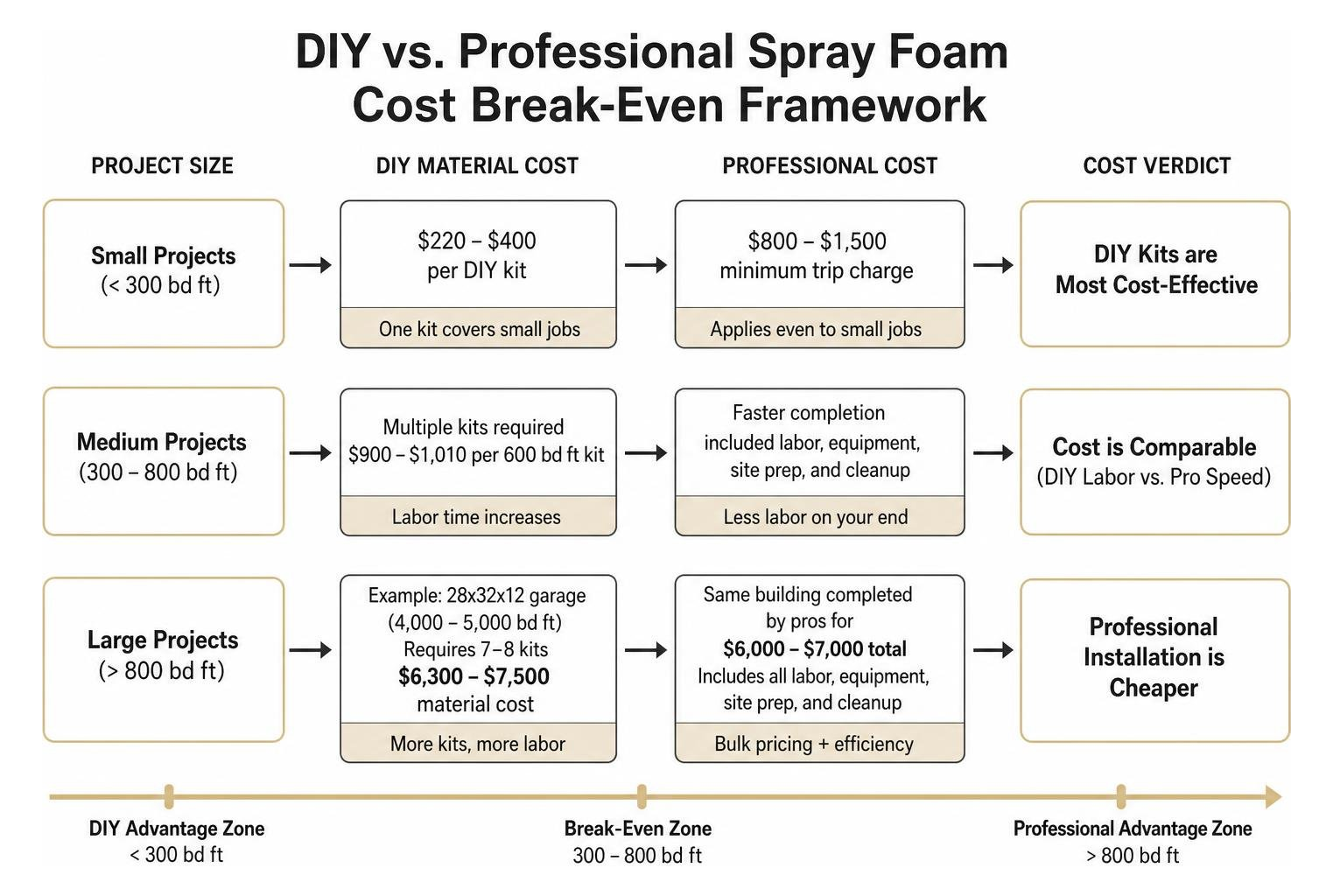
For small jobs—such as sealing band joists or insulating crawl space box sills—a $220 to $400 DIY kit is highly economical. Contractors carry minimum trip charges ($800 to $1,500) regardless of how small the job is.
However, on medium-to-large projects, the math shifts dramatically. For example, fully insulating a 28x32x12 garage (requiring roughly 4,000 to 5,000 board feet for a 2-inch closed-cell layer) would require seven to eight 600-board-foot DIY kits. At $900 to $1,010 per kit, DIY material costs alone range from $6,300 to $7,500.
Professional contractors buying bulk chemicals in 55-gallon drums typically complete that same building for $6,000 to $7,000 total—including all labor, site preparation, professional-grade equipment, and final cleanup. When undertaking complex projects like crawl space spray foam insulation, learning how to find the best spray foam insulation contractors near you can save thousands of dollars and ensure proper installation.
Hidden DIY Costs: PPE, Temperature Prep, and Mistake Prevention
Calculating the true DIY cost requires factoring in safety and environmental preparation gear:
- Personal Protective Equipment (PPE): Spraying two-component polyurethane produces airborne isocyanate mists. Safe installation requires a NIOSH-approved respirator fitted with organic vapor cartridges and P100 particulate filters ($45–$70), full Tyvek coveralls ($15–$25), chemical-resistant gloves ($10), and sealed eye protection ($15).
- Surface Preparation and Curing: Polyurethane sticks permanently to almost everything. Masking plastic, drop cloths, tape, and acetone solvent cleaners add $50 to $100 to the total budget.
- Off-Ratio Chemical Failures: If tanks drop below 68°F–77°F, component viscosity changes. An off-ratio spray results in either a brittle, crumbly mess (excess A-side) or a sticky, pungent foam that never hardens (excess B-side). Scraping uncured foam out of stud bays is a grueling, expensive ordeal.
When to Hire a Professional Instead of DIYing
DIY kits are not designed for whole-structure coverage. You should hire a licensed professional for:
- Large Structures: Insulating pole barns, commercial shops, and metal building spray foam insulation requires commercial proportioner rigs to apply continuous thermal barriers over steel framing.
- Occupied Living Envelopes: Whole-home retrofits must comply with local building codes, including continuous R-value thresholds and approved thermal/ignition barriers (such as 1/2-inch drywall or intumescent paint).
- Moisture-Critical Crawl Spaces: Complete ground-to-sill encapsulation demands seamless installation to prevent trapping ground moisture inside foundation framing.
Cost-Effective Spray Foam Strategies for Large Areas
For homeowners looking to maximize thermal efficiency on a strict budget, combining materials offers substantial savings over pure spray foam kits.
The "Flash-and-Batt" Method
Rather than filling a 2x6 wall cavity entirely with spray foam, use a "flash-and-batt" hybrid approach:
- Spray a 1-inch to 2-inch flash layer of closed-cell foam directly against exterior sheathing to create an airtight seal and vapor barrier (yielding ~R-6.5 to R-13).
- Fill the remaining cavity space with budget-friendly unfaced fiberglass or mineral wool batts.
- This cuts spray foam chemical costs by 50% to 65% while maintaining exceptional air tightness and achieving R-19 to R-21 overall thermal performance.
The Rigid Foam Board + Spray Seal Hybrid
On flat walls (such as pole barns, garage walls, and basement masonry), standard 4x8 rigid foam boards (polyisocyanurate or extruded polystyrene) provide an outstanding price-to-R-value ratio. Used or surplus 2-inch foam boards can often be sourced for around $12 to $25 per sheet.
- Cut rigid foam boards to fit snugly between wall studs or across purlins.
- Use a single-component gun-dispensed can kit (such as the ixirpro or BEEST systems) to spray expanding foam along every perimeter seam and joint.
- This hybrid strategy insulates large areas for a fraction of the cost of full-depth spray kits while matching closed-cell R-values. When updating older properties, combining this approach with comprehensive attic and crawl space insulation resolves structural drafts effectively.
Frequently Asked Questions About Budget Spray Foam
Where can I find discounted or surplus spray foam insulation?
Discounted two-component kits occasionally appear on surplus sites, online marketplaces, and store clearance shelves. However, verify the manufacture date stamped on the box. Never purchase kits past their 12-to-15-month shelf life or units that have been stored in unconditioned outdoor sheds. For rigid foam boards, architectural salvage yards and commercial roofing surplus dealers frequently sell factory "seconds" or reclaimed polyiso sheets at 50% to 70% below retail.
Can I spray closed-cell foam over existing insulation?
No. Never spray closed-cell polyurethane over existing fiberglass batts, loose-fill cellulose, or damaged substrates. Spraying foam onto fibrous insulation compresses the material, destroying its R-value, and prevents the foam from bonding to structural framing. Always remove old insulation, vacuum out dust, and inspect the framing before spraying.
How do I prevent wasting spray foam from clogged nozzles?
Two-component foam sets inside the mixing tip within 30 to 45 seconds of releasing the trigger. To prevent clogging:
- Keep spraying in steady, continuous passes rather than starting and stopping.
- Always keep a pack of spare helical fan and cone nozzles within reach.
- Have a can of acetone foam cleaner ready to flush the gun tip immediately if you pause spraying for more than 15 seconds.
- Ensure both tanks are warmed to 70°F–77°F before opening valves to maintain balanced chemical flow.
Conclusion: Getting the Most Insulation Value for Your Budget
Finding the right cheap spray foam insulation comes down to matching the product format to your project scale. For small band joists, air sealing, and localized touch-ups, multi-can kits like the BEEST FullStop and ixirpro packs provide high value without the risk of expired chemical tanks. For medium renovations, high-yield kits like the FROTH-PAK 630 and HandiFoam 600 offer reliable closed-cell performance if applied in a single work session.
However, once an insulation project crosses the 800 to 1,000 board-foot threshold, buying multiple DIY kits quickly costs more than professional installation. If you live in Virginia—including Richmond, Roanoke, Lynchburg, or Smith Mountain Lake—our team at Sweet Home Spray Foam provides high-performance spray foam insulation with transparent, upfront pricing and guidance on local energy rebates. Contact us today for a free estimate and discover the most cost-effective insulation strategy for your property.