
What Does It Cost to Spray Foam an Attic in 2026?
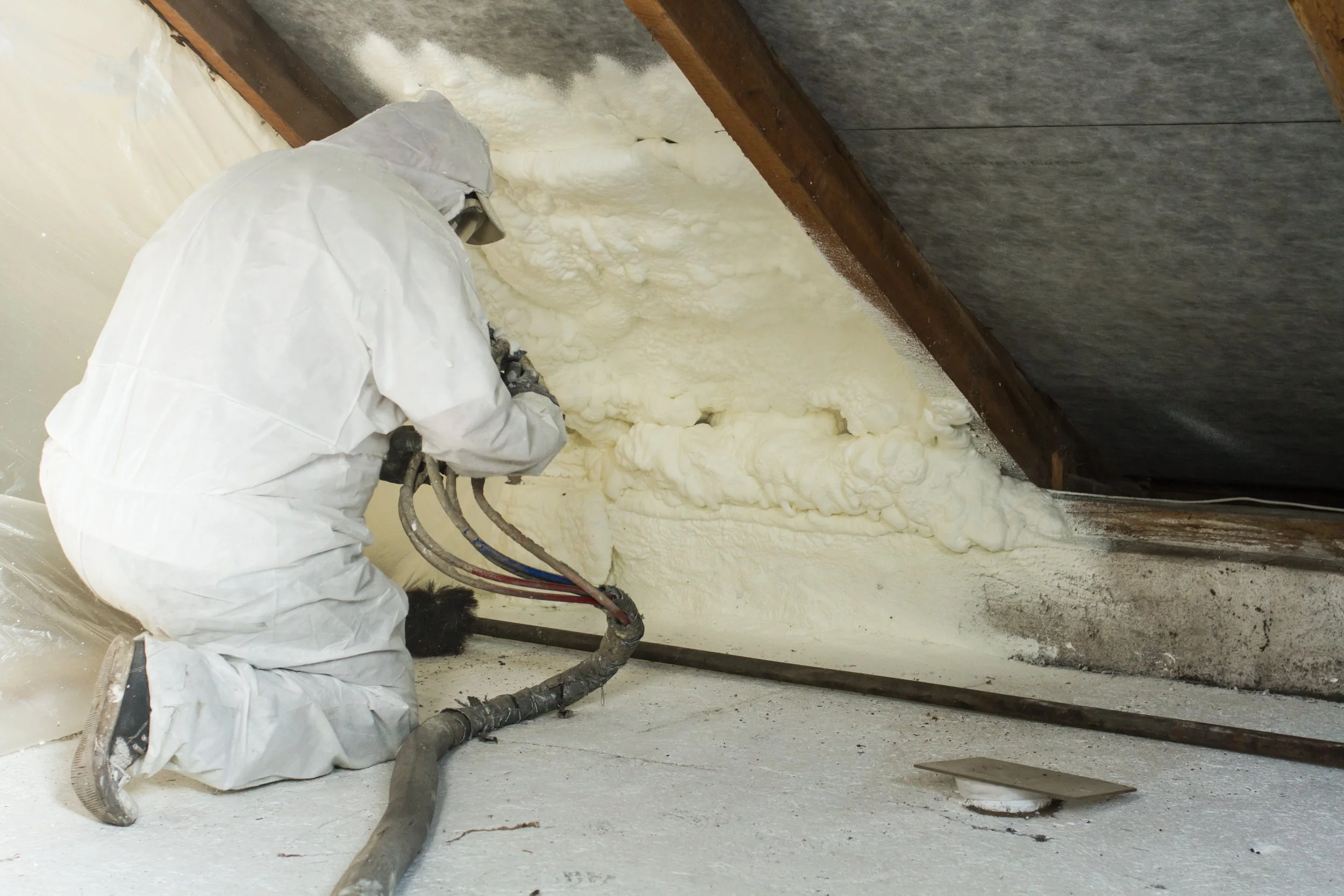
The cost to spray foam an attic usually falls between $1,221 and $3,132 nationally for a standard project. A 1,000-square-foot attic commonly costs about $2,200 to $4,100 with open-cell foam or $3,000 to $6,000 with closed-cell foam, installed.
Your final price depends on the area being sprayed, foam thickness, required R-value, whether the foam goes on the attic floor or roof deck, and prep work such as removing old insulation. Spray foam is priced by the board foot - one square foot of foam at one inch thick - so thickness matters as much as attic size.
For Virginia homeowners dealing with drafts, hot upstairs rooms, or rising utility bills, spray foam can cost more upfront than blown-in insulation. But it also air-seals the attic, which can reduce heating and cooling costs by 30% to 50% in the right home and installation.
This guide breaks down realistic 2026 pricing, open-cell versus closed-cell choices, added costs, potential local rebates, and how to compare contractor quotes without surprises.
Average Cost to Spray Foam Attic Spaces in 2026
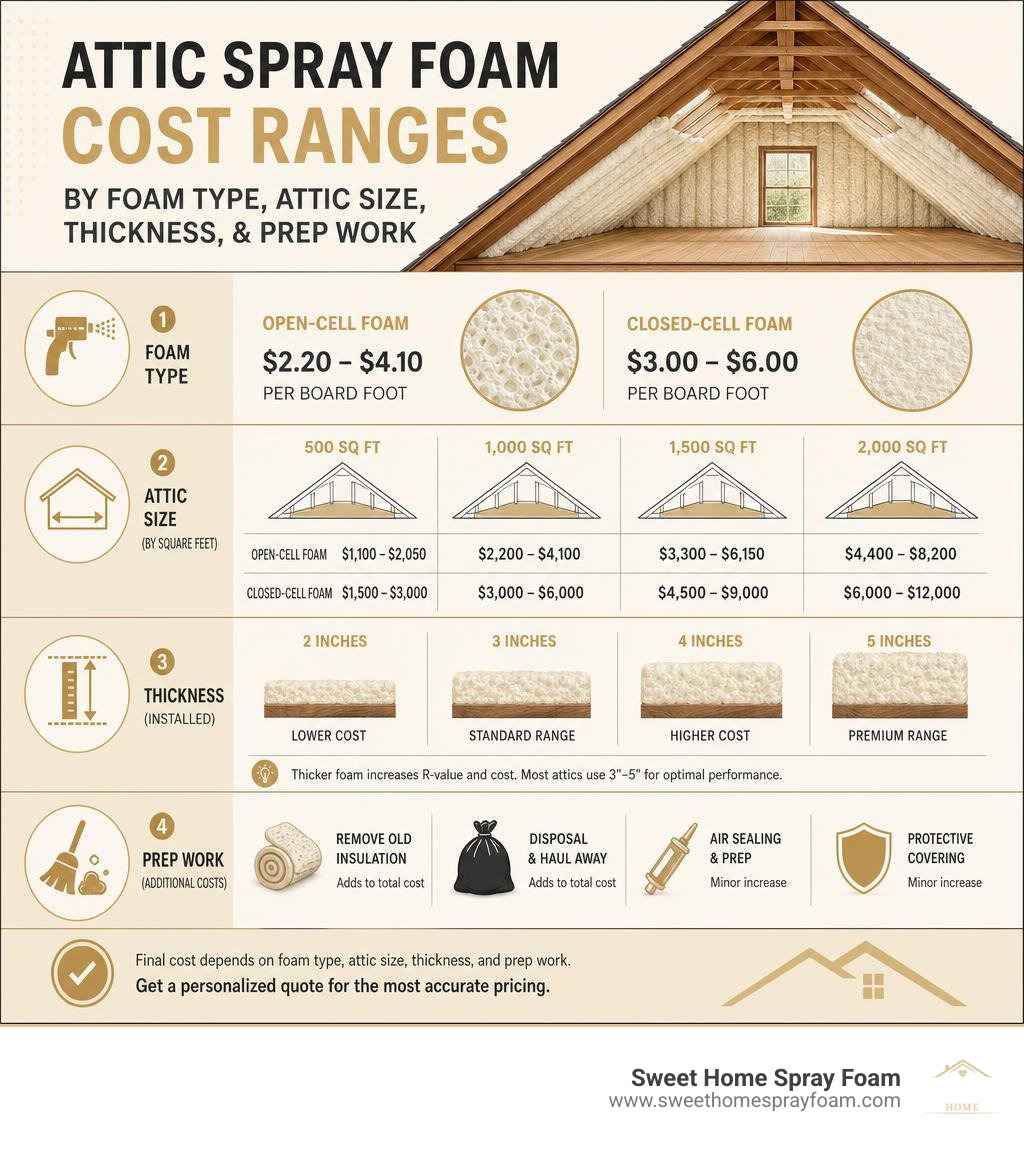
When estimating an attic project, knowing how contractors calculate costs helps you avoid surprises. Unlike traditional batt or rolled fiberglass, spray foam pricing centers on the board foot—a volume measurement equal to one square foot of surface area covered with one inch of cured foam.
To calculate board footage:
$$\text{Square Footage} \times \text{Thickness in Inches} = \text{Board Feet}$$
For instance, applying 3 inches of foam across a 1,000-square-foot attic deck requires 3,000 board feet. Nationally, installed material rates sit at:
- Open-cell spray foam: $0.40 to $0.75 per board foot
- Closed-cell spray foam: $1.00 to $2.00 per board foot
According to 2026 insulation cost benchmarks, standard attic retrofit budgets span from modest top-ups to complete conditioned roofline conversions. You can also review 2026 Spray Foam Attic Insulation Cost: Key Factors | Thumbtack for regional labor trends.
Here is a breakdown of what homeowners typically pay across common attic sizes:
| Attic Size (Sq. Ft.) | Open-Cell Cost ($0.40–$0.75/bf) | Closed-Cell Cost ($1.00–$2.00/bf) | Typical Application |
|---|---|---|---|
| 500 sq. ft. | $800 – $1,875 | $1,500 – $3,000 | Small attic floor / air-seal cap |
| 1,000 sq. ft. | $2,200 – $4,100 | $3,000 – $6,000 | Standard ranch attic or roofline |
| 1,500 sq. ft. | $1,500 – $3,750 (floor) / $3,300–$6,150 (roof) | $3,000 – $6,750 (floor) / $4,500–$9,000 (roof) | Two-story home full roof deck |
| 2,000 sq. ft. | $3,000 – $5,500 | $6,000 – $12,000 | Large residential footprint |
If you are planning an upgrade, reviewing our dedicated Attic Spray Foam Insulation service options can help you determine the best layout for your structure.
Open-Cell vs. Closed-Cell Cost to Spray Foam Attic
Choosing between open-cell and closed-cell foam is the single largest technical decision determining your project's price tag.
- Open-Cell Spray Foam (0.5 lb/cu. ft.):
- Installed Cost: $0.40 – $0.75 per board foot ($1.00 – $2.50 per sq. ft. at standard thicknesses).
- R-Value: Approximately R-3.6 to R-3.8 per inch.
- Characteristics: Soft, highly expansive, and excellent for acoustic sound dampening. Because it expands rapidly to fill deep rafter cavities, it is a cost-effective option for roofline encapsulation in moderate climates where a dedicated vapor barrier is added or not structurally required.
- Closed-Cell Spray Foam (2.0 lb/cu. ft.):
- Installed Cost: $1.00 – $2.00 per board foot ($2.00 – $4.50 per sq. ft. at standard thicknesses).
- R-Value: Approximately R-6.5 to R-7.0 per inch.
- Characteristics: Dense, rigid, and impermeable to moisture. Closed-cell acts as a code-approved vapor barrier at 2 inches or more and increases structural racking strength by up to 250%. It is the preferred solution where ceiling space is limited or moisture resistance is paramount.
Spray Foam Performance and Air Sealing Value
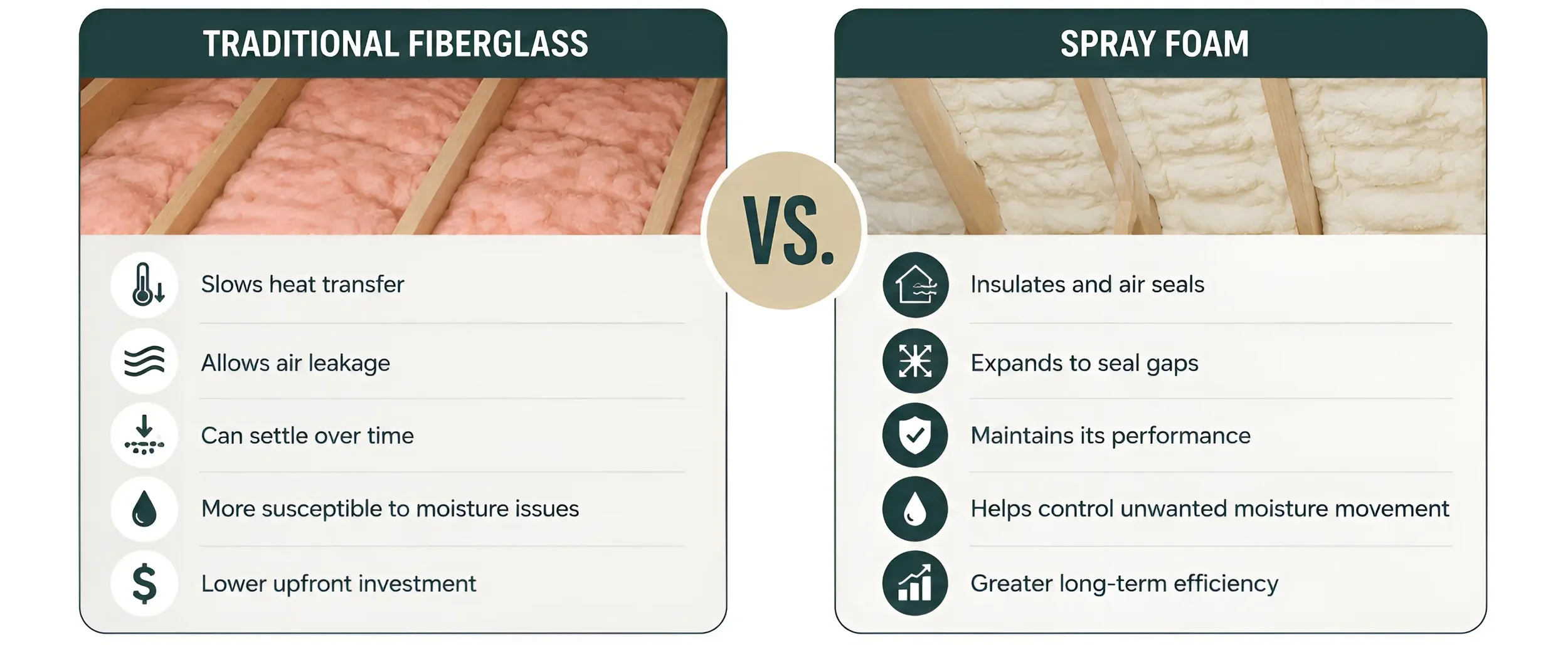
Why do homeowners invest in spray foam over budget-friendly blown-in materials? The answer lies in whole-home performance. Traditional blown-in cellulose or fiberglass allows convective airflow through tiny framing gaps.
Spray foam expands continuously, sealing penetrations around electrical chases, plumbing stacks, dropped soffits, and can lights. By eliminating air leakage—which accounts for nearly 40% of residential thermal loss—properly sealed attic assemblies reduce conditioned air loss and stop hot, humid summer air from entering living spaces.
Comparing Traditional vs Spray Foam Insulation highlights why spray foam provides superior performance: it combines an air barrier, vapor control layer (with closed-cell), and thermal resistance in a single installation step.
Key Factors That Influence Your Final Attic Foam Bill
Every attic possesses structural variables that alter labor requirements and material consumption.
- Application Area (Roof Deck vs. Attic Floor): Spraying an unvented roofline encapsulates the attic within the home's thermal boundary, keeping ductwork cool. However, because roof rafters have pitch and slope, the surface area is 20% to 40% larger than the flat attic floor, increasing total material volume.
- Attic Accessibility and Pitch: Cramped crawl spaces, low roof clearances, complex hip roofs, and steep pitches require extra staging and slow down application speed, slightly raising labor costs.
- Climate Zone and Code Requirements: Building codes (such as the 2021 IECC) dictate regional thermal targets. In Virginia (Climate Zone 4), attic targets generally call for R-38 to R-49 on flat vented floors, or code-compliant prescriptive R-values (R-20 to R-30+) when encapsulating unvented rooflines with continuous air barriers.
- Project Size and Minimum Rig Charges: Spray foam rigs require specialized diesel generators, heated hoses, and proportioner pumps. Most contractors maintain a minimum trip charge of $1,200 to $1,500 to cover operational setup on smaller projects under 500 square feet.
Additional Prep Work and Hidden Cost to Spray Foam Attic Projects
A thorough estimate should include any necessary site prep before the spray guns turn on:
- Old Insulation Removal: If your attic contains contaminated, rodent-damaged, or compressed fiberglass/cellulose, it must be extracted via high-powered vacuums before spraying. Removal generally costs $1.00 to $2.50 per square foot.
- Air Sealing Pre-Prep: Sealing oversized chases or installing baffles can add $300 to $600 to standard prep work.
- Thermal and Ignition Barriers: Building codes (IRC Section R316) require exposed foam to be protected from fire. If your attic is used for storage or houses mechanical equipment, contractors must apply an approved ignition barrier (such as intumescent fire-retardant paint) over the foam, adding $0.40 to $0.80 per square foot.
- Moisture Remediation & Deck Repairs: Any active roof leaks or rotted wood decking must be resolved before foam application.
For homes with moisture problems in lower levels, pairing your attic upgrade with Crawl Space Spray Foam Insulation creates an airtight thermal envelope from top to bottom. Read our guide on comprehensive Attic and Crawl Space Insulation systems to understand how these zones interact.
Professional Installation Considerations
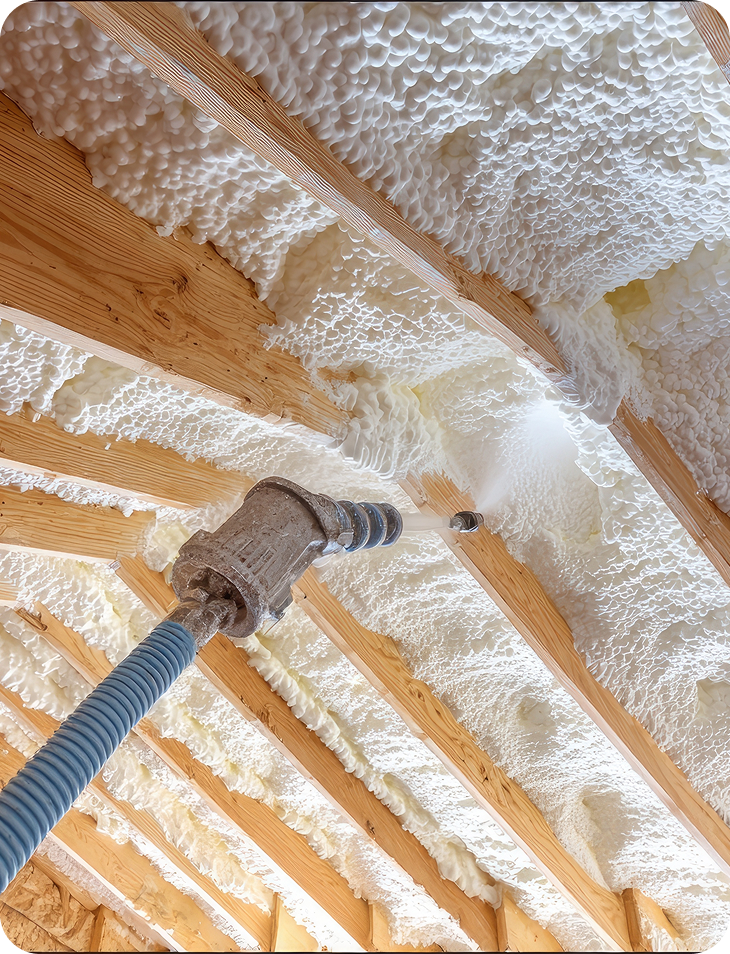
Attic spray foam involves precise on-site polymer chemistry. Two liquid components (Isocyanate "A-side" and Polyol resin "B-side") are heated to 130°F, pressurized to 1,200+ PSI, and mixed at the spray gun tip.
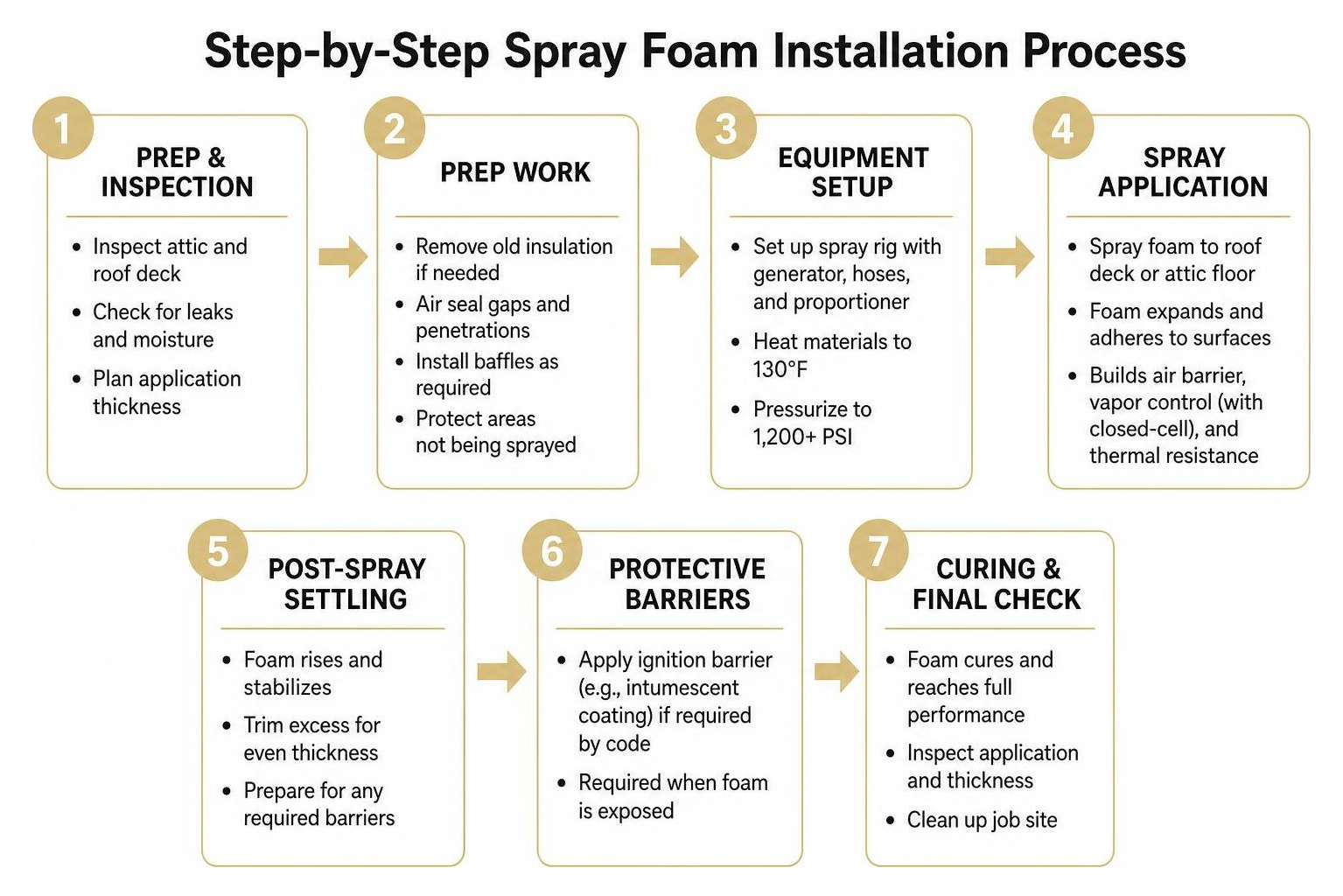
Attempting a DIY whole-attic installation with retail kits carries significant risks:
- Temperature Sensitivity: Substrate temperatures below 50°F or above 90°F can cause improper chemical reactions, poor adhesion, and off-ratio curing.
- Off-Ratio Foam: Incorrect mixes can lead to lingering odors or lower R-values.
- Safety Protocols: Professional technicians use supplied-air respirators (SAR), chemical-resistant suits, and industrial exhaust fans to maintain negative air pressure and clear volatile organic compounds during curing.
Return on Investment, 2026 Rebates, and Long-Term Value
While spray foam requires a higher initial investment than basic fiberglass batts, its return on investment (ROI) is among the strongest of any building envelope upgrade:
- Heating and Cooling Savings: Homeowners typically see an immediate 15% to 30% reduction on monthly energy bills (and up to 50% when replacing old, severely degraded insulation).
- HVAC Longevity: Conditioned attics reduce summer temperatures from 140°F+ down to within 10 degrees of your living area, drastically lowering strain on HVAC equipment and ductwork.
- Payback Period: With annual utility savings ranging from $480 to $1,400, the average payback period is 3 to 8 years.
- Home Resale Appeal: Tighter building envelopes, lower utility bills, and transferable warranties enhance property appraisals and buyer interest.
2026 Rebates and Tax Credit Realities
Staying up to date on incentive programs helps maximize your budget:
- Federal Tax Credits: The federal Section 25C Energy Efficient Home Improvement Credit was terminated on December 31, 2025. As a result, no federal tax credit applies to insulation installations completed in 2026.
- Local Utility Rebates: Electric utilities across Virginia (such as Dominion Energy and regional electric cooperatives) offer energy-efficiency rebates ranging from $50 to $400+ for qualifying attic insulation upgrades and air sealing.
To explore current pricing models and independent cost estimators, you can reference resources like the Spray Foam Insulation Cost Calculator (2026), Polyurethane Spray Foam Insulation Cost: Prices, Per Foot, and Job Factors in the U.S. 2026 – Current Cost, and the Spray Foam Insulation Cost Calculator — 2026 Estimator | Efficienco.
Contractor Vetting and Quote Comparison
When reviewing bids, ensure you are comparing equivalent scopes of work:
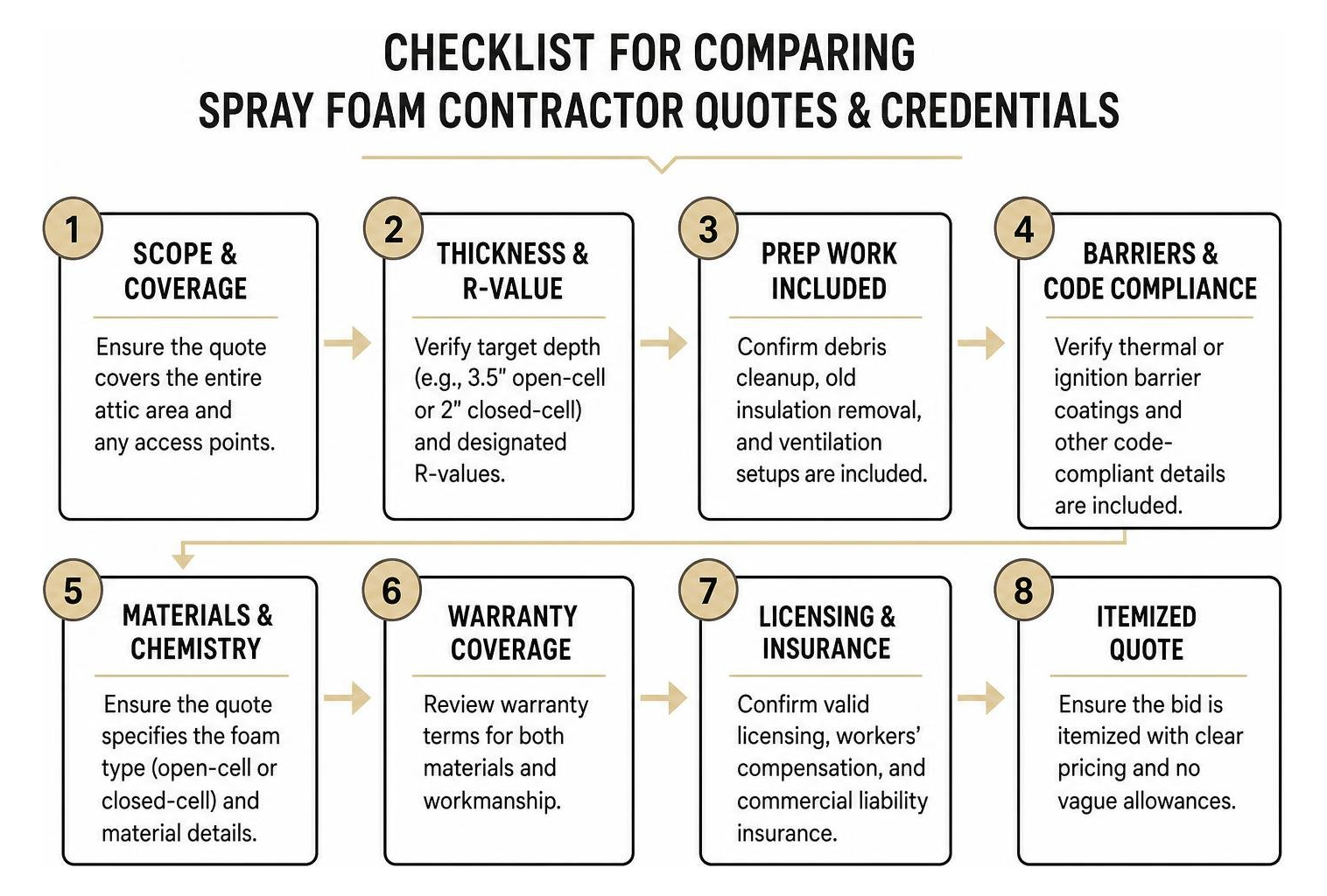
When vetting local installers, look for:
- Clear Board-Foot and Thickness Metrics: The estimate should clearly list target depth (e.g., 3.5 inches open-cell or 2 inches closed-cell) and designated R-values rather than vague terms like "foam sealed."
- Itemized Prep Work: Verify that debris cleanup, old insulation removal, and ventilation setups are transparently documented.
- Licensing & Insurance: Ensure your installer carries valid workers' compensation and commercial liability coverage.
- Code-Compliant Barriers: Bids should specify whether thermal or ignition barrier coatings are included.
For a deeper dive on contractor selection, check out our guide on how to Find the Best Spray Foam Insulation Contractors Near You, and browse our general Insulation Education hub for technical insights.
Frequently Asked Questions About Attic Spray Foam Costs
How long does spray foam insulation last in an attic?
Professionally installed spray foam lasts 80 years or more—essentially the lifetime of your home. Unlike fiberglass batts or blown cellulose, spray foam will not sag, settle, compress, or degrade over time. It maintains its full design R-value and air-sealing properties indefinitely as long as your roof remains watertight.
Do I need to leave my home during spray foam installation?
Yes. Safety standards require homeowners and pets to vacate the premises during spraying and remain offsite for 24 to 48 hours afterward. This allows the two-part chemical mixture to fully cure and ensures all application off-gassing is cleared by our high-powered negative-air ventilation systems.
Are there any federal tax credits for spray foam in 2026?
No. The federal Section 25C Energy Efficient Home Improvement Credit expired on December 31, 2025. However, state and local electric utility companies and EMCs continue to offer direct rebates and financing programs for attic air sealing and insulation retrofits.
Conclusion
Understanding the factors behind spray foam attic costs helps you balance upfront pricing against decades of energy savings and indoor comfort. For more national pricing perspectives, read How Much Does Spray Foam Insulation Cost in 2026? Complete Price Guide | FindSprayFoam.
At Sweet Home Spray Foam, we believe homeowners deserve honest guidance, transparent pricing, and quality craftsmanship. We proudly serve homeowners across Virginia—including Richmond, Roanoke, Lynchburg, and Smith Mountain Lake.
Whether you need a targeted attic floor air seal or a full roofline encapsulation, our team provides pressure-free assessments to help you choose the right system for your home and budget. Contact Sweet Home Spray Foam today to schedule your free, no-obligation attic evaluation!