
How Cement Lifting Foam Levels Sunken Concrete
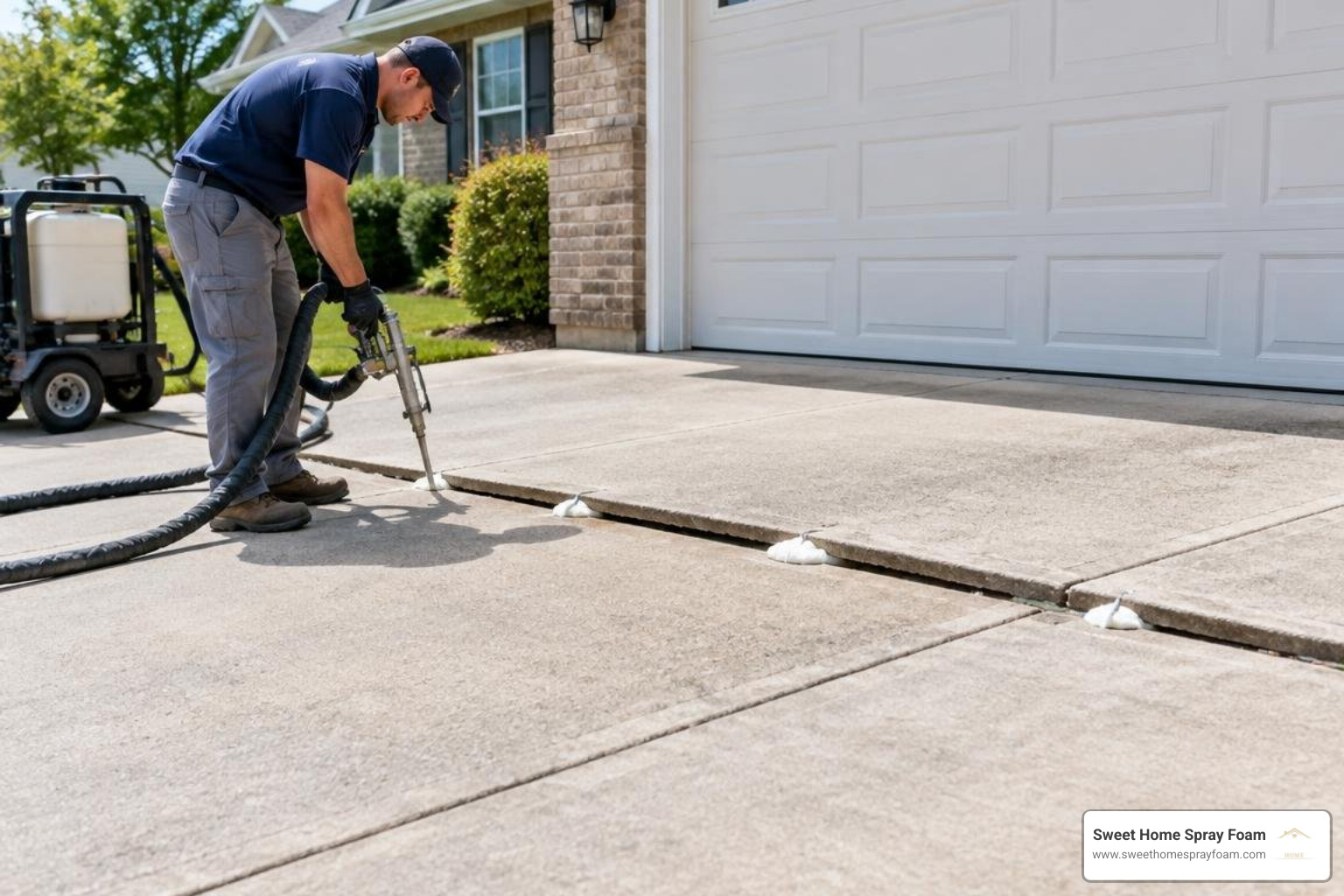
Cement lifting foam is an expanding polyurethane used to raise and support sunken concrete. A contractor injects it through small holes in the slab. The foam spreads into gaps beneath the concrete, then expands to lift the slab as it hardens.
For a settled driveway, sidewalk, or patio, this can restore a more even surface without tearing out and replacing the slab. The foam is much lighter than the cement-based mix used in traditional mudjacking. But lifting the slab is only part of the fix: the contractor also needs to check why the ground beneath it settled, or the problem may return.
What Is Cement Lifting Foam and How Does It Work?

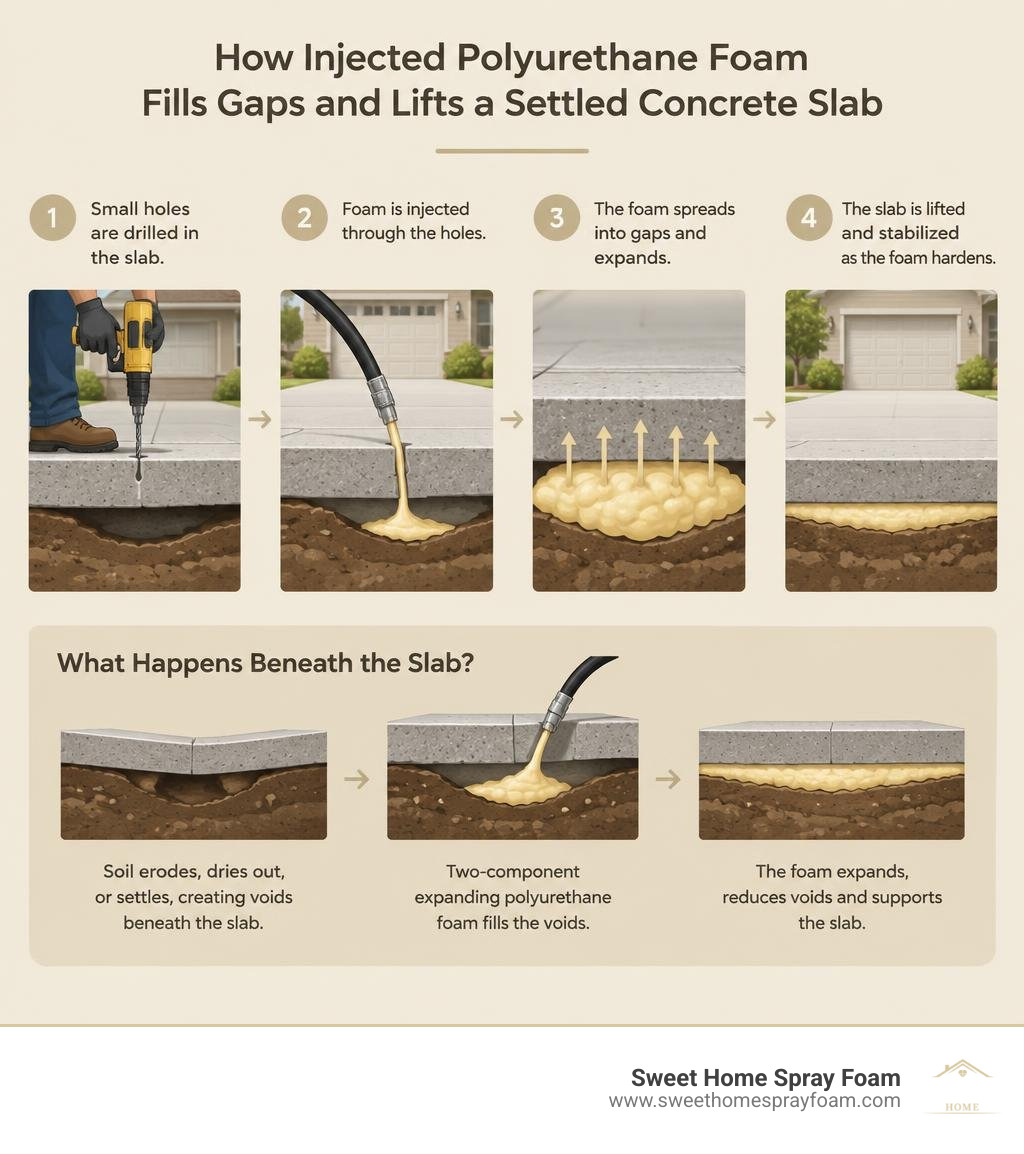
When soil under a concrete slab erodes, dries out, or settles due to poor initial compaction, unsupported empty pockets known as voids form. Without proper subgrade support, heavy concrete slabs inevitably crack, sink, or tip.
Cement lifting foam solves this underlying void issue through controlled polymer expansion. The material is a specialized two-component, closed-cell, high-density polyurethane system. When Component A (an isocyanate) and Component B (a formulated polyol resin blend) meet at the tip of an injection gun, a rapid chemical reaction begins.
As the liquid components combine, they flow into hidden subterranean paths, following the line of least resistance. Within seconds, the liquid transforms into an expanding foam matrix that pushes into loose soil aggregates, consolidates weak earth, and fills structural gaps. Once the voids are completely packed, the continued controlled expansion generates tremendous upward hydraulic force, gently and precisely lifting the heavy slab back to its target elevation.
Engineers and contractors often refer to high-performance formulations like Precision Lift® 4.75# when calculating load requirements for structural soil densification and heavy slab lifting.
Technical Specifications, Expansion, and Reaction Times
Polyurethane lifting foam relies on high-yield chemistry engineered for load-bearing applications. The material balances low liquid viscosity for deep void penetration with rapid structural curing to give installers exact control over lift heights.
- Compressive Strength: Achieves 100 psi (pounds per square inch), which equals 14,400 psf (pounds per square foot) under ASTM D-1621 testing. This strength easily supports residential vehicles, commercial freight, and municipal machinery.
- Tensile Strength: Reaches 100 psi per ASTM D-638, providing internal structural cohesion.
- Expansion Ratio & In-Place Density: Features an unconfined expansion ratio of roughly 15x, resulting in an in-place structural density of 4.75 to 5.0 lbs/cu ft (ASTM D-1622).
- Dimensional Stability: Demonstrates zero shrinkage once cured according to ASTM D-1042 / D-756 standards. It will not shrink or separate from the concrete underside over time.
- Viscosity: Measures 270–280 centipoise (cP), delivering a thin, water-like initial consistency that readily navigates small soil voids before expanding.
- Solids Content: 100% solids formulation, ensuring no VOC shrinkage, off-gassing volume loss, or water washout during reaction.
- Mixing Ratio: Strict 1:1 volumetric ratio between Part A and Part B.
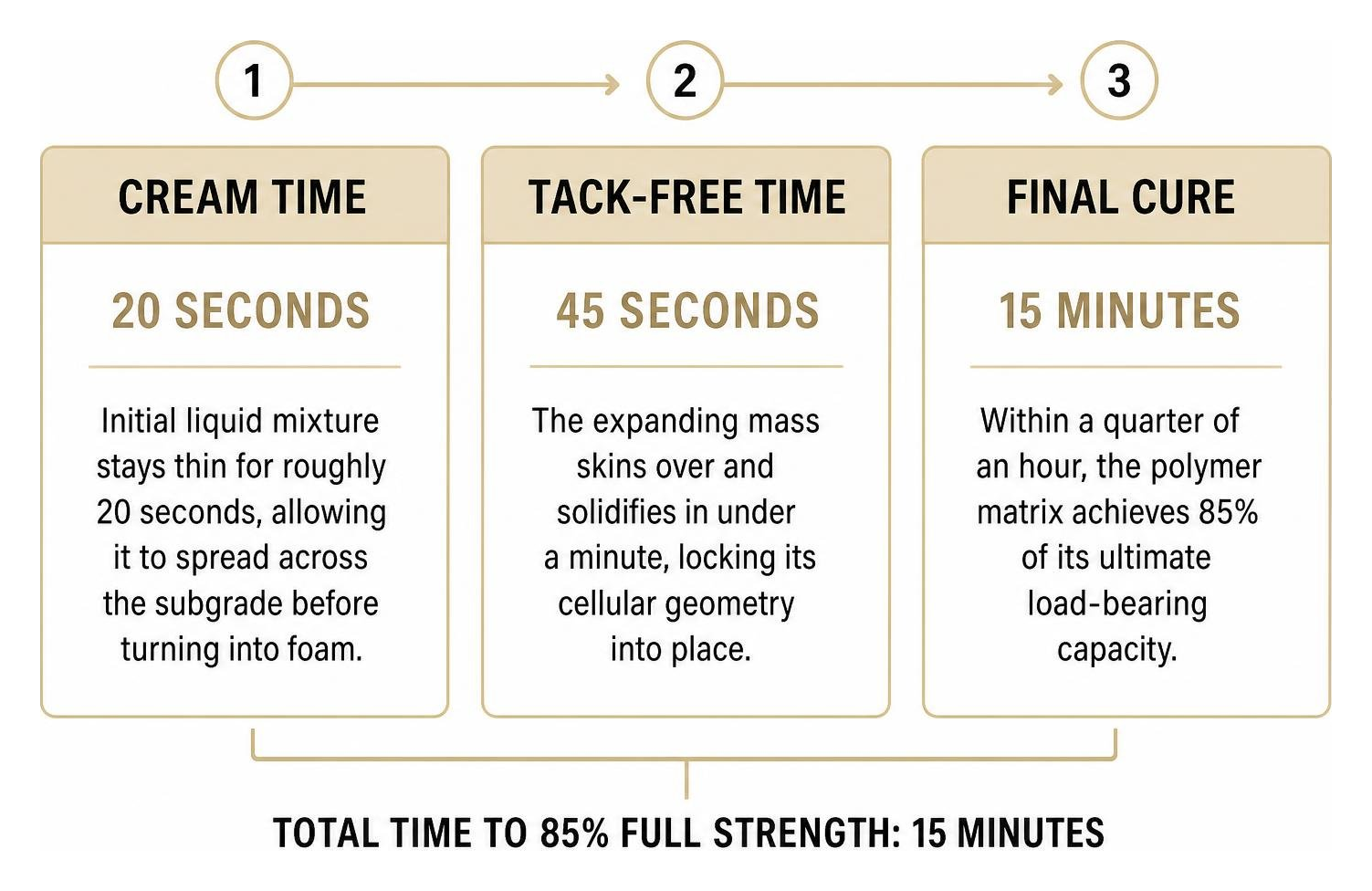
The chemical reaction timing is critical during application:
- Cream Time (20 Seconds): The initial liquid mixture stays thin for roughly 20 seconds, allowing it to spread across the subgrade before turning into an expanding foam.
- Tack-Free Time (45 Seconds): The expanding mass skins over and solidifies in under a minute, locking its cellular geometry into place.
- 85% Full Strength (15 Minutes): Within a quarter of an hour, the polymer matrix achieves 85% of its ultimate load-bearing capacity, allowing for near-immediate traffic return.
Primary Structural Applications for Cement Lifting Foam
While homeowners encounter sunken concrete around patios, sidewalks, pool surrounds, and driveways, high-density polyurethane lifting foam is also engineered for extreme commercial, civil, and industrial applications:
- Residential Flatwork: Pool decks, patios, front walkways, garage floors, and sunken driveway approaches.
- Highway & Interstate Pavements: Leveling stepped highway joints and undersealing rocking concrete slabs under heavy interstate traffic.
- Airport Infrastructure: Stabilizing airport runways, taxiways, and tarmac slabs where prolonged downtime is impossible.
- Bridge Approaches: Raising settled approach slabs to eliminate jarring vehicular bumps at bridge joints.
- Utility Vaults & Pipes: Stabilizing and sealing around municipal utility vaults, manholes, and precast concrete pipes to eliminate groundwater intrusion and soil migration.
- Foundation Support: Void-filling and stabilizing concrete lifting foundations to stop progressive structural settlement.
Polyurethane Foam Leveling Benefits
Historically, concrete leveling relied heavily on mudjacking—pumping a heavy slurry of topsoil, water, and Portland cement underneath slabs through large, intrusive holes. While mudjacking had its day, high-density polyurethane foam offers significant performance advantages.
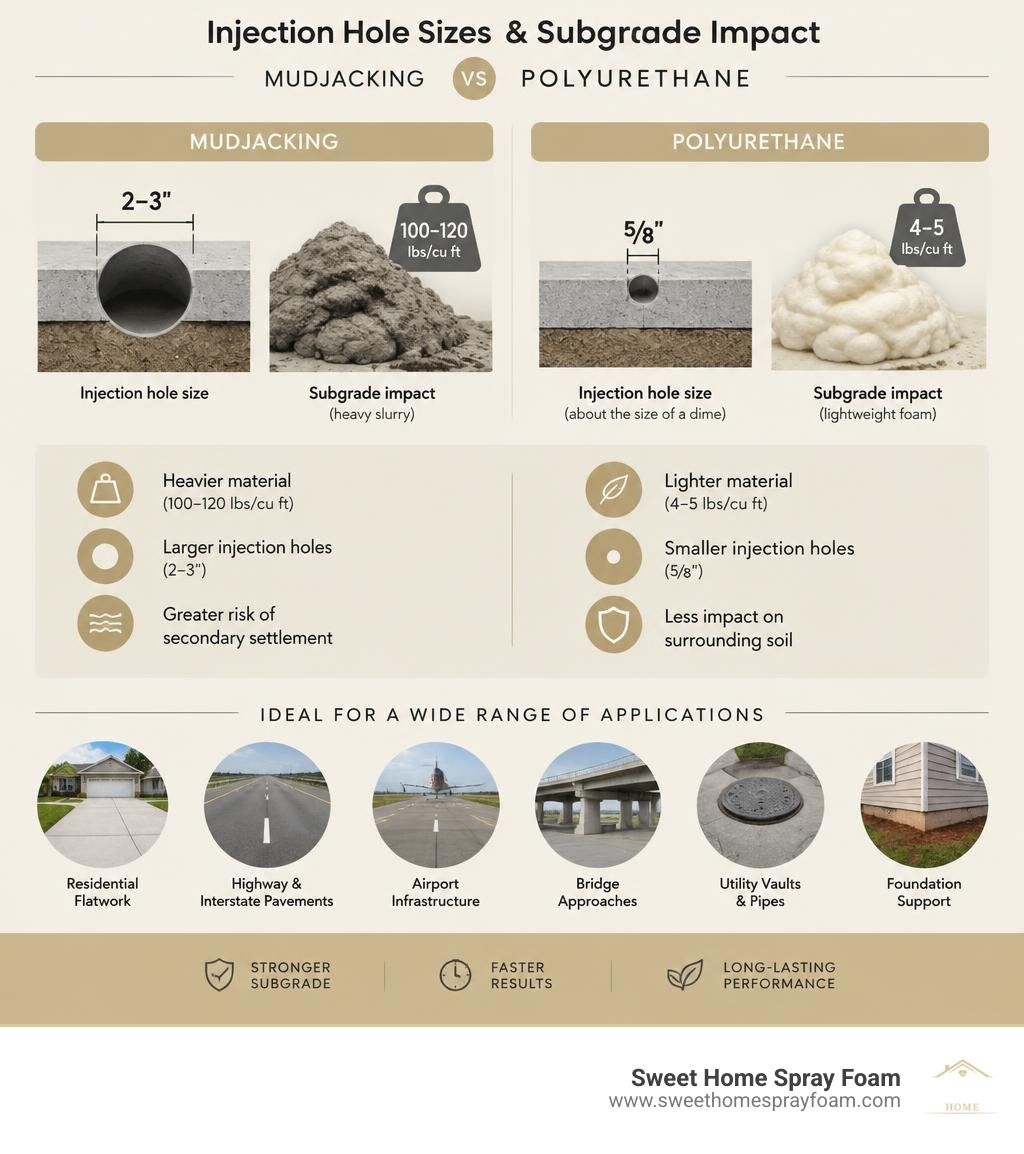
Because polyurethane foam expands up to 15 times its liquid volume, it weighs only 4 to 5 pounds per cubic foot. In contrast, traditional mudjacking grout weighs between 100 and 120 pounds per cubic foot. Adding tons of heavy mudjacking grout onto already weak, settling soil often triggers secondary settlement down the road.
Polyurethane foam requires only small 5/8-inch injection holes (about the size of a dime), compared to the 2- to 3-inch core holes needed for mudjacking equipment. This preserves the surface appearance and structural integrity of the slab.
| Feature | Polyurethane Foam Lifting | Traditional Mudjacking |
|---|---|---|
| Material Weight | 4.75 – 5.0 lbs/cu. ft. (Extremely lightweight) | 100 – 120 lbs/cu. ft. (Heavy burden on soil) |
| Injection Hole Size | 5/8-inch (Dime-sized, discrete) | 1.5 to 3.0 inches (Large, noticeable patches) |
| Cure Time | 15 minutes (Ready for immediate use) | 24 to 72 hours (Extended downtime) |
| Moisture Resistance | Hydro-insensitive; will not wash away | Vulnerable to water erosion and leaching |
| Subgrade Action | Compresses soil and fills micro-fissures | Fills large cavities; adds heavy deadweight |
| Shrinkage Factor | 0% shrinkage after cure | Shrinks and cracks as water evaporates |
Proper Installation, Material Handling, and Environmental Factors
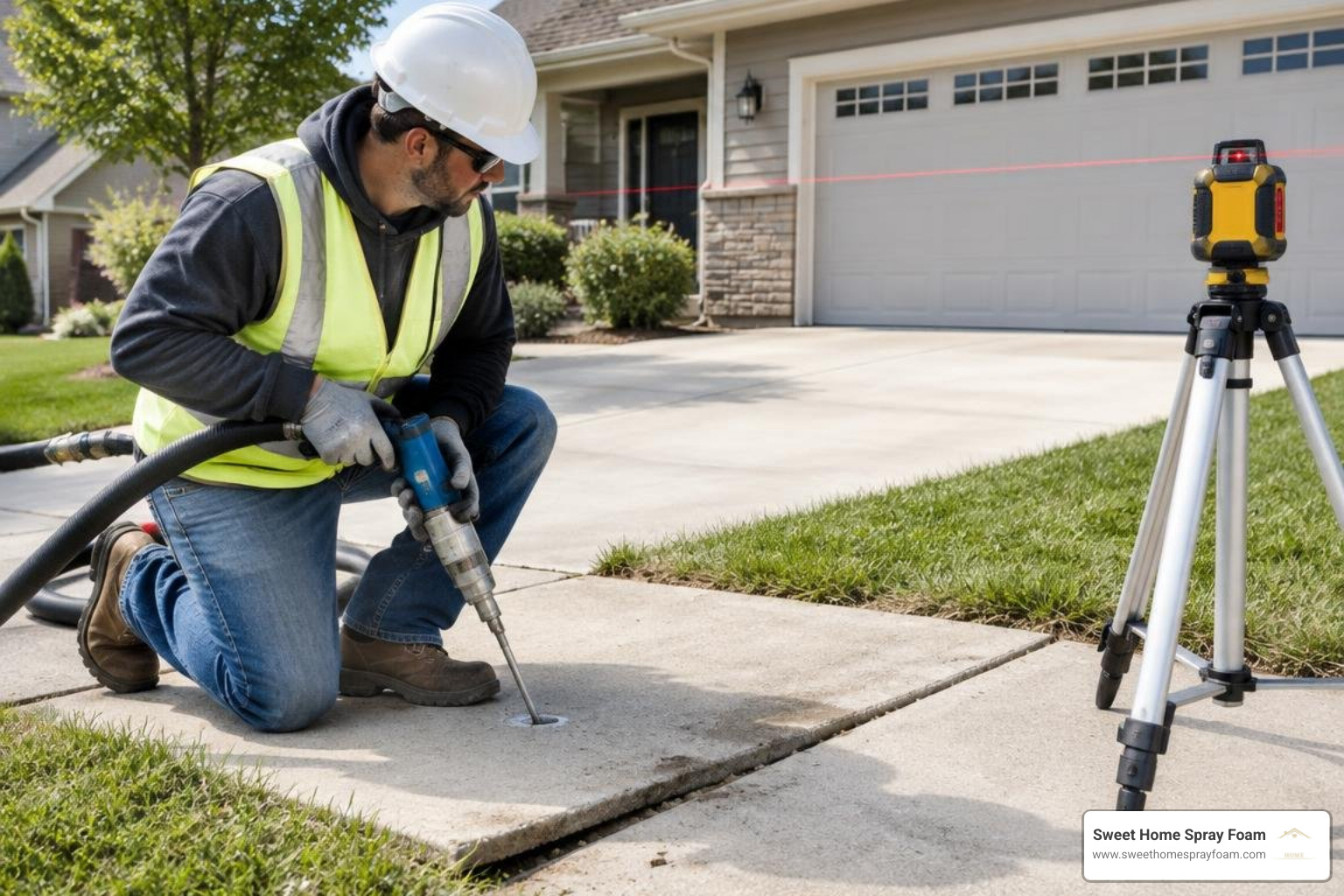
Successful concrete lifting requires precise chemical management and specialized installation rigs. When selecting experienced concrete leveling contractors, homeowners should verify that the crew uses calibrated proportioning pumps and temperature-controlled storage systems.
Material handling best practices include:
- Temperature Conditioning: Polyurethane chemical drums must be stored between 40°F and 80°F in a dry environment. Before injection, both chemicals should be conditioned to an optimal processing temperature of 70°F to 80°F to maintain balanced viscosity and equal flow rates.
- Application Temperatures: While cured foam performs in all weather conditions, ambient and substrate temperatures during injection must stay above 40°F. Colder temperatures slow down chemical reactivity and increase liquid viscosity, which can disrupt the 1:1 mixing ratio.
- Pre-Mixing Resin: The B-side component contains catalysts, blowing agents, and surfactants that can separate over time. It must be mechanically agitated prior to application to ensure consistent density, cell structure, and reaction speed.
Environmental Resistance and Safety of Cement Lifting Foam
A major advantage of structural lifting foam is its hydro-insensitive chemistry. It does not absorb moisture, dissolve in standing groundwater, or lose structural integrity in damp soil. During injection, the expanding foam actively displaces trapped water beneath the slab, creating a moisture-resistant barrier that helps protect the slab from future frost heave and erosion.
Polyurethane is chemically stable and inert once cured. It does not leach chemicals into adjacent soils, will not alter ground pH, and resists breakdown from soil microbes and subterranean pests.
During the injection process, technicians follow standard safety practices:
- OSHA PPE Protocols: Installers wear nitrile or chemical-resistant gloves, protective eye goggles or full-face shields, long sleeves, and appropriate respirators when working in unventilated or confined spaces.
- Solvent Cleaning: Uncured chemical residues are cleaned from tools using acetone or specialized solvent flushes. Once the foam cures, it becomes completely insoluble and can only be removed mechanically or with specialized stripping agents.
Frequently Asked Questions About Concrete Foam Leveling
How long does polyurethane concrete lifting foam last?
Polyurethane concrete lifting foam is designed as a permanent structural repair. Because closed-cell polyurethane is a non-biodegradable, cross-linked polymer, it will not decompose, rot, or break down underground over time. It is completely unaffected by freeze-thaw cycles, moisture exposure, soil bacteria, or subterranean insects.
Unless the soil beneath the treated area washes away due to uncontrolled water drainage, cement lifting near me provides a permanent, long-term repair for sinking concrete.
Can foam lifting be performed in wet ground conditions?
Yes. High-density structural lifting foams are hydro-insensitive, meaning their reaction kinetics, expansion profiles, and cured densities remain consistent even in the presence of water. The expanding foam actively displaces standing groundwater under the slab, making it an ideal solution for leveling seawalls, lakefront walkways, pool surroundings, and drainage swales.
How soon can concrete be used after foam injection?
Concrete treated with polyurethane foam can be used almost immediately. The foam reaches 85% of its ultimate structural compressive capacity within roughly 15 minutes of injection.
Foot traffic can resume immediately after the small injection holes are patched with matching cementitious grout. Heavy vehicular traffic—including passenger cars, delivery trucks, and RVs—can drive across the surface within 30 minutes of repair. If you are comparing local options, exploring concrete lifting foam near me can help you find contractors equipped with quick-setting polyurethane systems.
Conclusion: Restoring Your Concrete with Modern Polyurethane Solutions
Sunken concrete driveways, tipped sidewalk slabs, and uneven patios are more than just an eyesore—they present genuine trip hazards, alter proper drainage paths toward your home's foundation, and reduce your property's value.
Replacing settled concrete is disruptive, messy, and expensive, often costing thousands more than targeted stabilization. By choosing high-density cement lifting foam, you get a clean, minimally invasive repair that stabilizes the sub-base, permanently fills voids, and restores your slabs to their original position in just a few hours.
At Sweet Home Spray Foam, we bring high-performance spray foam expertise, clear upfront pricing, and pressure-free service to homeowners throughout Virginia, including Richmond, Roanoke, Lynchburg, and Smith Mountain Lake. If you are ready to eliminate tripping hazards and level your sunken slabs for good, reach out to our team today for expert concrete lifting and foundation stabilization.