
How Cement Mud Jacking Lifts a Sinking Slab
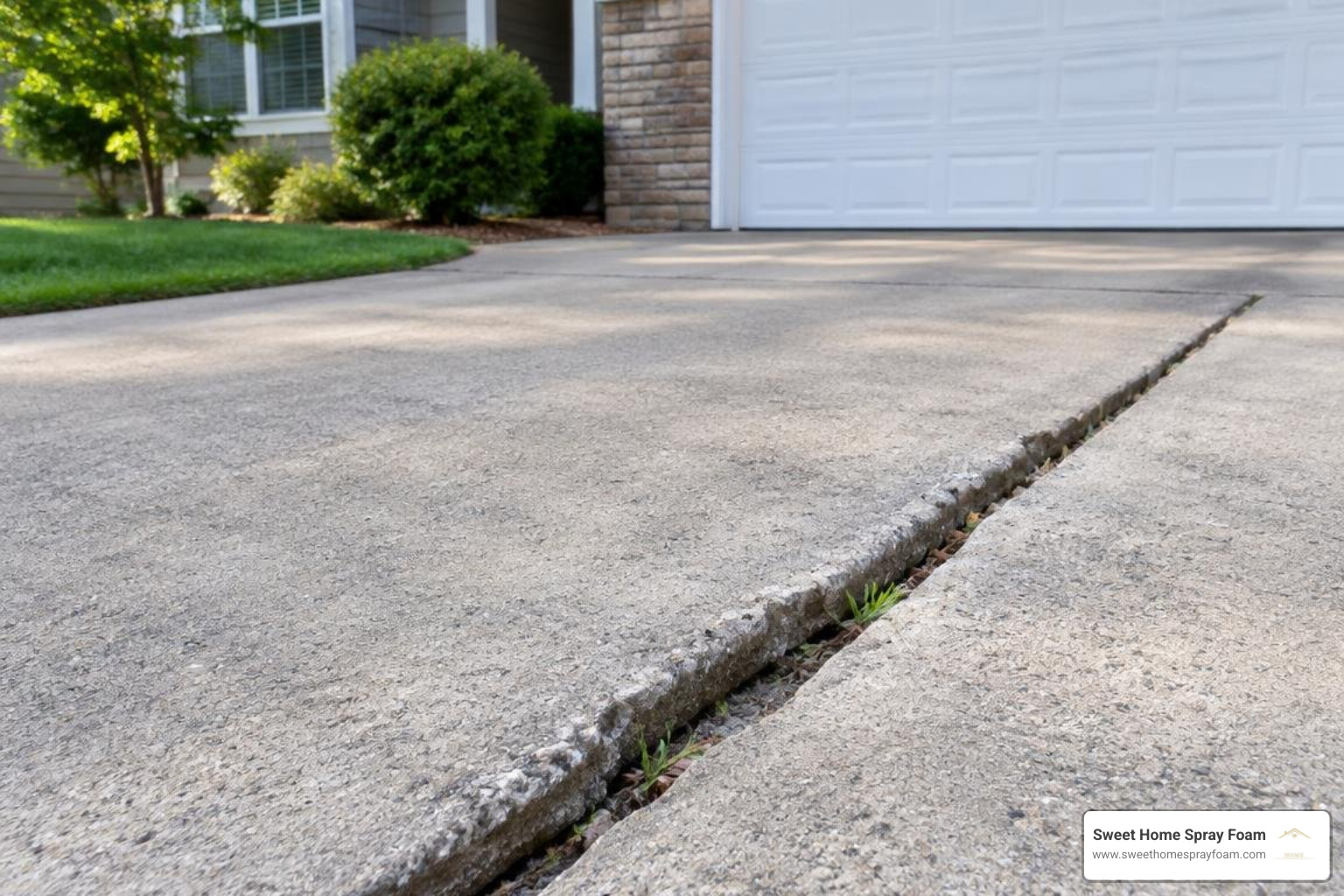
Cement mud jacking raises a settled concrete slab without tearing it out. A crew drills holes in the slab, pumps a cement-based slurry beneath it to fill gaps and lift it, then patches the holes. If your driveway, walk, or patio has sunk, start by checking whether the concrete is mostly intact and where water may be washing soil away. A damaged slab or an unresolved drainage problem can make lifting a poor fix.
The method dates back to the early 1900s, though today's mixes use cement rather than actual mud. For a Virginia homeowner, it can remove a trip hazard with less disruption than replacing the slab.
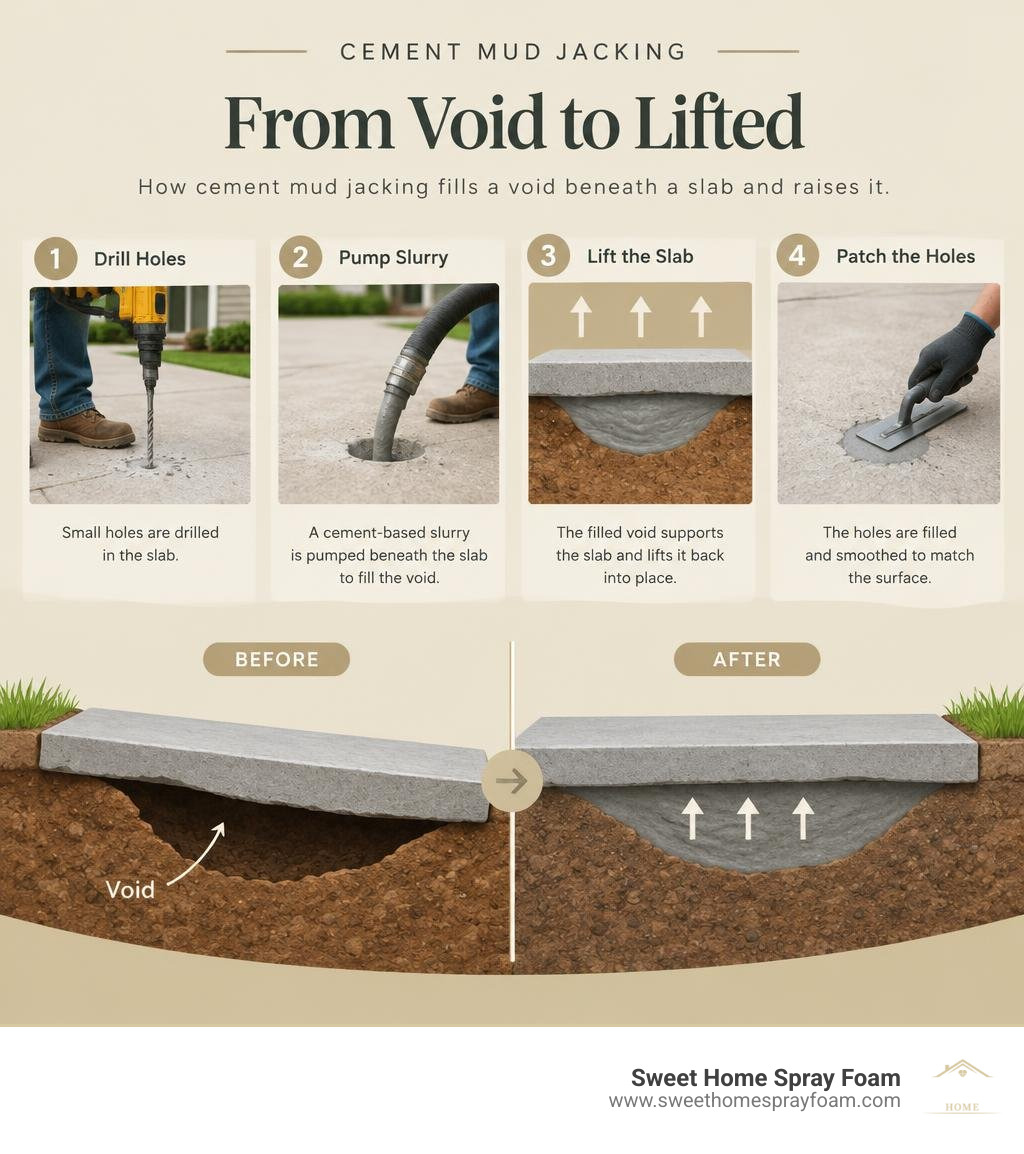
Understanding Cement Mud Jacking and How It Works
When a concrete walkway, driveway, or patio begins to tilt or drop, the issue almost never starts within the concrete itself. Concrete is rigid and strong in compression, but it depends entirely on the ground beneath it for structural support. When underlying dirt washes out, settles, or compacts unevenly, hollow pockets known as sub-slab voids develop. Without ground contact, gravity pulls the heavy concrete downward into the open void.
Cement mud jacking fixes this problem by targeting the empty space directly beneath the fallen slab. Rather than demolishing the slab with jackhammers and hauling away heavy debris, technicians pump a dense, cementitious mixture directly beneath the concrete under controlled hydraulic pressure.
Modern mud jacking slurry typically blends Portland cement, finely crushed limestone aggregate, local screened soils or clay additives, and water. This mixture remains fluid enough to travel smoothly through delivery hoses and spread across open gaps under the slab. Once pumped beneath the concrete, the slurry fills the hollow cavity from the bottom up. As the void fills completely, the hydraulic pressure generated by the pump creates an upward lifting force that gently raises the concrete back toward its original grade.
Once cured, this traditional slurry develops a compressive strength of roughly 2,400 psi (pounds per square inch). That load-bearing capacity easily handles residential driveways, heavy passenger vehicles, and commercial foot traffic. For homeowners interested in proven methods for slabjacking to safely lift concrete slabs, traditional mud jacking offers a reliable, time-tested approach to structural stabilization.
Mudjacking vs. Slab Jacking vs. Pressure Grouting
In the concrete repair industry, several terms are often used interchangeably, though they have subtle technical differences:
- Mudjacking (or Mud Jacking): The traditional term for lifting sunken flatwork using an earth-and-cement slurry pumped through 1.5- to 2-inch access holes.
- Slab Jacking: A broader umbrella category that encompasses any method used to lift a concrete slab back into position. This includes cementitious slurry lifting as well as modern polyurethane foam injection.
- Pressure Grouting: A specialized geotechnical process often utilized in deep-foundation repair, commercial infrastructure, or structural wall void filling. Pressure grouting typically uses higher pump pressures and specialized cement formulations to stabilize loose, deep sub-soils rather than simply leveling surface-level flatwork.
When addressing sunken patios, pool decks, or sidewalks, many property owners choose specialized cement slab lifting solutions tailored to their specific sub-base conditions.
Why Concrete Sinks in the First Place
Understanding why your concrete settled in the first place is essential for ensuring a permanent repair. In our Virginia service areas—from Richmond and Charlottesville to Lynchburg and Roanoke—several distinct environmental and human factors cause slabs to drop:
- Improper Backfill Compaction: During original construction, soil excavated around foundation walls, utility trenches, and garage footings must be thoroughly compacted with heavy equipment. If backfilled loosely, the soil naturally consolidates over 5 to 15 years, creating large voids beneath walkways and driveways.
- Soil Consolidation and Settlement: Natural undisturbed soil can compress when subjected to sustained heavy loads, especially if original site grading was inadequate.
- Water Runoff and Erosion: Misdirected downspouts, lack of seamless gutter systems, and unsealed expansion joints allow rainwater to channel beneath flatwork. As water flows, it carries fine sand and silt particles away, hollowing out the sub-base.
- Expansive Clay Shrinkage: Much of Central and Western Virginia features clay-heavy soil. During hot, dry summer months, clay loses moisture, shrinks dramatically, and pulls away from the underside of slabs. When autumn rains return, the weakened ground can no longer support the heavy slab.
- Burrowing Pests: Small rodents like moles, groundhogs, and chipmunks frequently dig tunnels under warm concrete slabs. These small tunnels quickly act as natural drainage channels during storms, rapidly accelerating soil erosion.
- Plumbing Leaks: Hidden leaks in underground irrigation lines or sewer lines introduce excess moisture, softening the soil and washing out the gravel bedding beneath the concrete.
The Complete Concrete Leveling Process
The actual execution of a mud jacking job requires precision, specialized pumping machinery, and constant visual monitoring to prevent over-lifting or surface cracking.
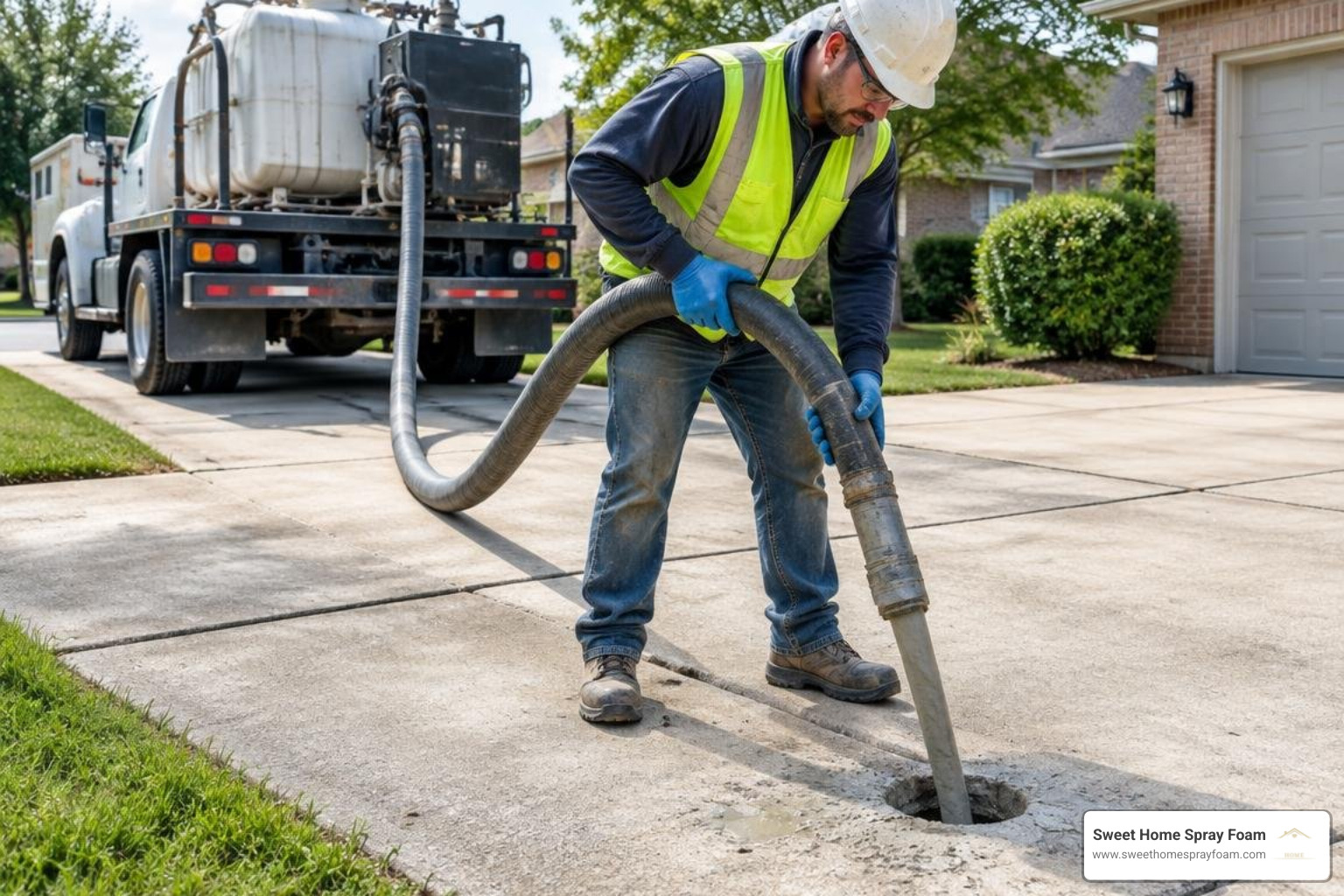
A professional leveling crew arrives on site with a self-contained pump truck or trailer. The support vehicle remains parked safely on the street or driveway apron, keeping heavy automotive weight off your lawn. Technicians run heavy-duty, flexible delivery lines directly to the work area, allowing them to navigate through narrow backyard fence gates without tearing up grass or gardens.
Elevation throughout the lifting sequence is tracked using optical level gauges, string lines, or precision laser levels. Technicians control pump rates in small bursts, allowing the slurry to migrate, displace pockets of water, and elevate the slab gradually.
Pre-Job Site Assessment and Preparation
Proper preparation ensures a smooth job. Property owners should complete a brief preparation routine:
- Clear the Surface: Remove all patio furniture, grills, planters, vehicles, and storage items from the slab.
- Inspect Slab Condition: Identify existing structural cracks versus simple surface hairline crazing.
- Locate Underground Utilities: Ensure buried shallow lines, low-voltage landscape lighting, or invisible pet fences are marked.
- Mark Sprinkler Components: Flag all lawn irrigation heads near the edge of the slab so technicians do not step on them or pinch them with hoses.
- Address Drainage Faults: Ensure gutters, downspouts, and landscape grading direct roof runoff away from the repair area.
Executing the Cement Mud Jacking Injection Step-by-Step
Once the site is secured and prepped, the leveling procedure follows a proven sequence:
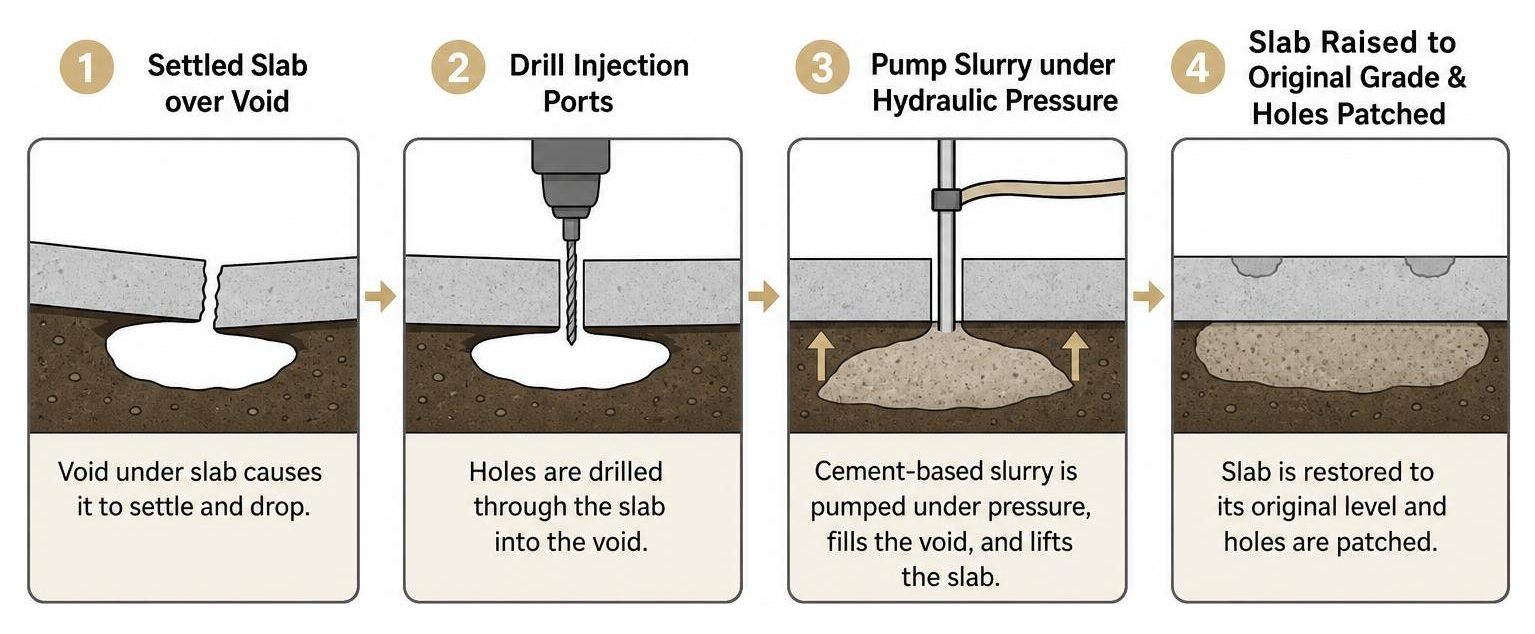
- Step 1: Drilling Injection Ports: Using a heavy-duty rotary hammer drill with a masonry bit, technicians drill a grid of 1.5- to 2-inch diameter holes through the sunken slab. Ports are spaced 3 to 6 feet apart depending on the slab's thickness and reinforcement.
- Step 2: Mixing the Slurry: Portland cement, aggregate, and water are mixed in the hopper to a smooth, uniform consistency that flows under mechanical pressure while retaining enough body to support weight.
- Step 3: Controlled Hydraulic Injection: A tapered injection nozzle is secured into the first access port. The hydraulic pump injects the slurry, filling voids beneath the lowest section of the concrete.
- Step 4: Systematic Raising: Technicians rotate between ports in a staged pattern. This distributes lifting forces evenly across the panel, preventing point-loading stress that could cause new fractures. Mud jacking can lift panels that have dropped anywhere from 0.25 inches up to 4.5 inches back into alignment. For garage floors that pitch the wrong way, these methods help homeowners level a garage floor cleanly without tearing out the base slab.
Hole Patching and Return-to-Service Timelines
After the slab has been brought flush with adjoining panels and proper drainage pitch is re-established, the injection ports must be closed.
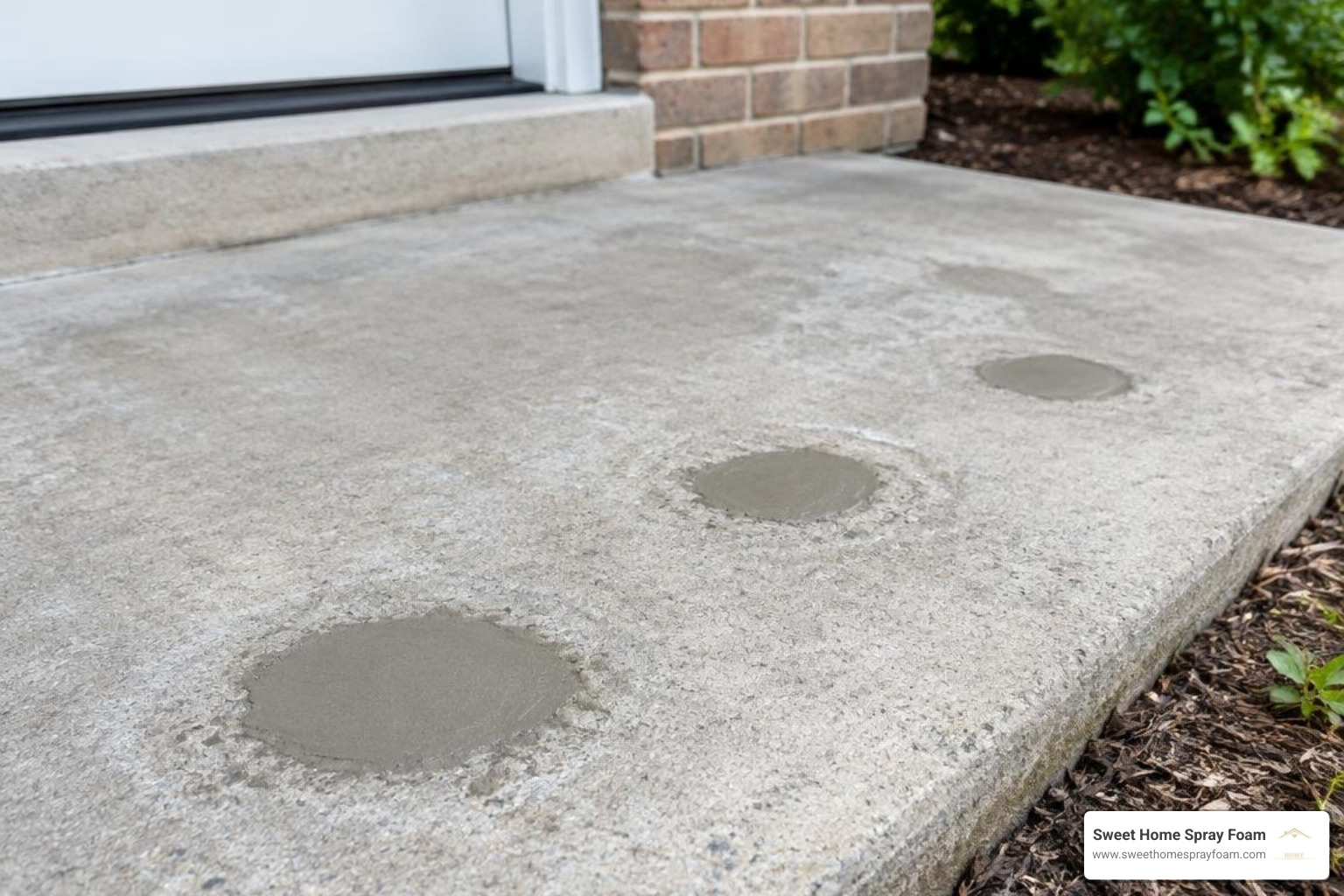
Technicians clear residual slurry from the top 2 inches of each hole and pack them with a non-shrink, high-strength Portland-based patching mortar. The surface of each plug is hand-troweled flush with the surrounding concrete finish.
Because cement slurry relies on standard hydraulic cement curing, return-to-service timelines are straightforward:
- Pedestrian Foot Traffic: Allowed almost immediately, typically within 1 to 2 hours after cleanup.
- Standard Passenger Cars: Permitted within 4 to 6 hours after project completion.
- Heavy Trucks and Commercial Equipment: Must wait 24 to 48 hours to allow the slurry to reach its full 2,400 psi compressive strength.
Property owners looking for experienced help can consult professional concrete leveling contractors to review site conditions and ensure proper curing procedures.
Comparing Slab Repair: Mud Jacking vs. Foam
Over the past few decades, high-density polyurethane foam injection (often called polyjacking) has joined traditional mud jacking as a modern alternative. Both approaches avoid the costly demolition of concrete replacement, but their material profiles differ.
| Feature / Metric | Traditional Cement Mud Jacking | Polyurethane Foam Lifting |
|---|---|---|
| Primary Material | Portland cement, soil, limestone aggregate | Closed-cell, expanding structural polyurethane |
| Material Weight | 100 to 140 lbs per cubic foot | 2 to 4 lbs per cubic foot |
| Drill Hole Diameter | 1.5 to 2.0 inches (about silver-dollar size) | 5/8 inch (about dime size) |
| Typical Cost | $3 to $6 per square foot | $5 to $10 per square foot |
| Cure Time to Drive | 4 to 6 hours (light cars), 24 hrs (heavy loads) | 15 to 30 minutes |
| Moisture Resistance | Stable under normal conditions; vulnerable to heavy washouts | 100% waterproof; highly resistant to moisture erosion |
| Lift Control | Controlled hydraulic push | Expanding chemical reaction |
How Cement Mud Jacking Compares to Polyurethane Foam
The biggest difference between the two systems is weight and hole size. Cured cement slurry weighs between 100 and 140 pounds per cubic foot. On solid sub-bases that simply experienced voiding from localized washouts, this dense mass forms a rock-solid, concrete-like foundation that bears immense weight. However, on highly compressible, boggy soils, adding heavy cement slurry can occasionally overburden the ground, leading to secondary settlement over time.
In contrast, expanding polyurethane foam weighs just 2 to 4 pounds per cubic foot while expanding 15 to 25 times its liquid volume to gently lift slabs without burdening fragile soils. Polyurethane injection requires smaller 5/8-inch holes, making the injection points less visible after patching. For those weighing their investment, evaluating cement lifting foam costs alongside traditional methods provides a clear picture of project value.
Cost Breakdown: Mud Jacking
Traditional cement mud jacking typically ranges between $3 and $6 per square foot, or approximately $500 to $2,000 per section or panel, depending on the extent of voiding underneath.
By choosing mud jacking, homeowners routinely save a significant portion of what a full slab replacement would otherwise cost, while getting their driveway or patio back into service the same afternoon. When searching for local concrete mudjacking options, asking for an upfront site evaluation helps confirm total square footage and required slurry volumes.
Applications, Limitations, and Long-Term Durability
Mud jacking handles a wide variety of flat concrete slabs across residential and light commercial properties.
Common applications include:
- Sunken Driveway Panels: Leveling slabs that have dropped where the driveway meets the garage threshold.
- Front Steps and Entry Stoops: Raising entry steps that have pulled away from exterior siding.
- Sidewalks and Walkways: Eliminating trip hazards cited by municipal inspectors or HOAs.
- Patios and Pool Decks: Removing standing water puddles and aligning settling deck joints.
- Garage and Basement Floors: Correcting floor settlement before installing epoxy or tile finishes.
- Commercial Slabs: Leveling settled warehouse floors and delivery bays to maintain safe forklift operations.
For complex structural concerns around home perimeters, our team also provides solutions for lifting foundation concrete to maintain overall structural stability.
When Mud Jacking Works Best (and When It Doesn't)
While cement mud jacking is versatile, it is not a universal cure for every concrete defect.
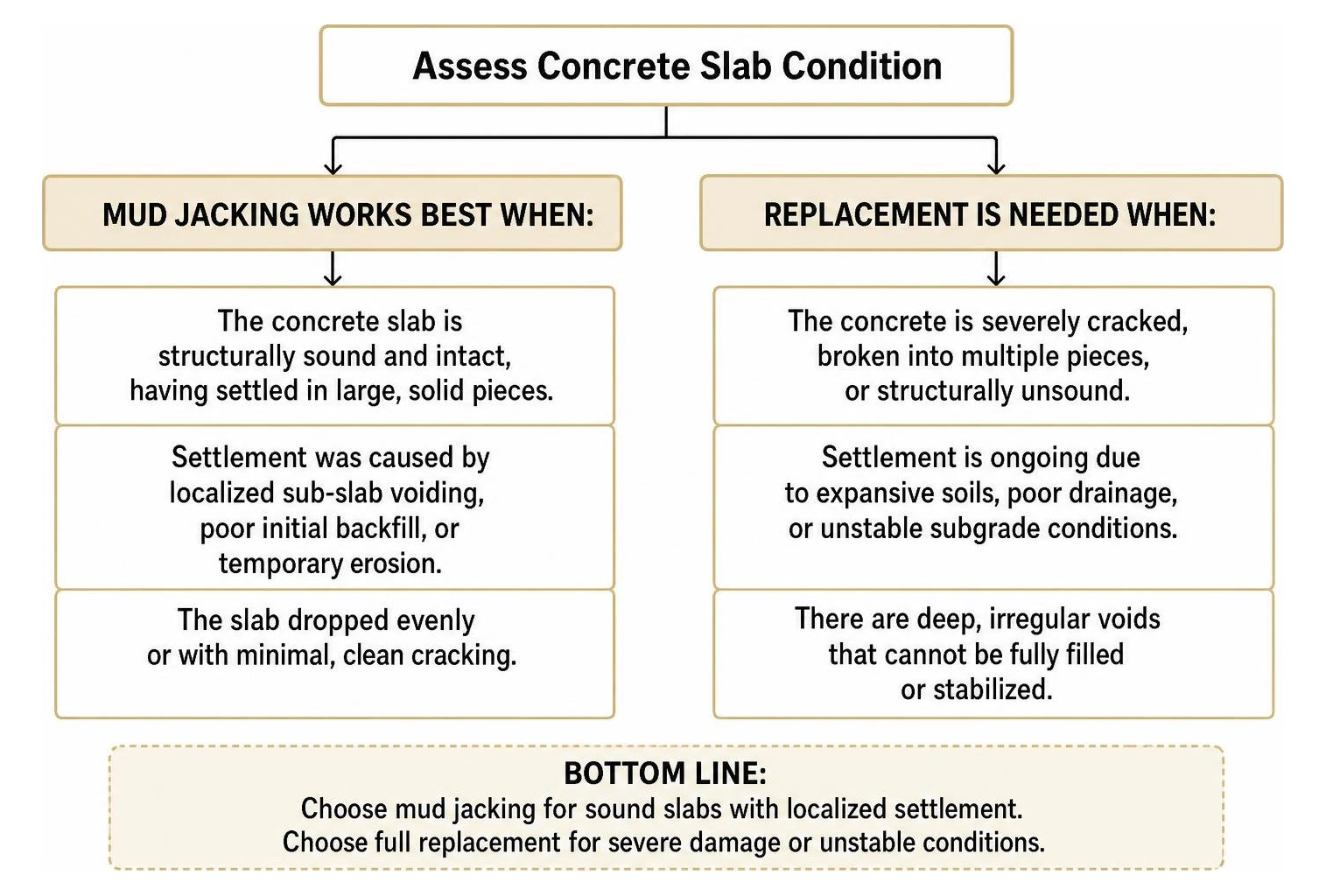
Mud Jacking Works Best When:
- The concrete slab is structurally sound and intact, having settled in large, solid pieces.
- Settlement was caused by localized sub-slab voiding, poor initial backfill, or temporary erosion.
- The slab dropped evenly or with minimal, clean cracking.
Mud Jacking Is NOT Recommended When:
- Severely Fragmented Slabs: Concrete broken into small pieces ("alligator cracked") cannot be jacked uniformly. Pumping slurry under fragmented rubble will cause individual pieces to tilt in different directions. Such concrete requires complete replacement.
- Active Structural Wall Foundations: Slabs that bear primary structural wall loads and have settled due to deep foundation failure cannot be stabilized by surface slab jacking alone.
- Proximity to Fragile Retaining Walls: Pumping heavy slurry directly behind an unreinforced or leaning retaining wall can exert lateral hydraulic pressure, causing the wall to bow or fail.
- Severe Tree Root Uplift: When concrete has been pushed upward by tree roots, mud jacking cannot lower the slab. In these cases, the slab section must be removed so root obstructions can be cleared before repouring.
Expected Lifespan and Essential Post-Lift Maintenance
A professionally performed cement mud jacking job can easily last 5 to 10 years or longer—often matching the remaining operational lifespan of the concrete itself. However, because the slurry rests upon the underlying soil, its long-term durability depends on preventative moisture management.
To protect your investment and prevent future soil washouts:
- Seal All Cracks and Joints: Apply a high-grade polyurethane or silicone elastomeric concrete joint sealant along every open seam, saw-cut control joint, and drill patch. This prevents surface water from penetrating beneath the slab.
- Extend Gutter Downspouts: Route roof runoff at least 5 to 10 feet away from walkways, driveways, and foundation walls.
- Maintain Proper Soil Grading: Ensure soil, mulch, and flowerbeds along the edges of the slab slope downward away from the concrete to promote water runoff.
- Control Pests: Fill animal burrows near the perimeter of driveways and patios before rodents create new underground water channels.
Frequently Asked Questions About Slab Leveling
Will the patched drill holes be visible on my concrete?
Yes, patched injection holes will be visible initially. Technicians drill 1.5- to 2-inch diameter ports and fill them flush with a high-strength, non-shrink Portland cement patching grout.
Fresh patching mortar has a lighter, cleaner appearance than older, weathered concrete. However, as the patch cures, collects ambient dust, and experiences rainfall and foot traffic, the color contrast softens. Within several months of natural outdoor weathering, the patches blend into the surrounding surface.
Can mud jacking fix cracked concrete slabs?
Mud jacking can lift cracked slabs provided the concrete is still in large, cohesive sections. Slabs with single longitudinal or transverse cracks can be brought level, closing trip hazards across the break.
However, mud jacking cannot fuse or structurally "glue" broken concrete back together. Once the panels are raised flush, the crack itself must be sealed with an elastic joint sealant to keep moisture out. If a slab has shattered into multiple fragmented chunks, lifting is no longer practical, and pouring fresh concrete is the better route.
How long does a typical mud jacking job take from start to finish?
Most residential mud jacking projects—such as a sunken two-car driveway, front walkway, or patio—take between 1 and 4 hours from initial setup to final cleanup.
Larger commercial jobs or complex pool decks can take up to a full day. Because the equipment operates externally and delivery hoses run directly to the work area, disruptions to your daily routine or business operations are minimal.
Conclusion: Choosing the Right Concrete Leveling Solution
Sunken, uneven concrete creates trip hazards, pools water toward your foundation, and reduces your property's curb appeal. Tearing out and replacing sunken slabs is disruptive, messy, and expensive. Traditional cement mud jacking remains a practical, cost-effective method to raise settled concrete back to grade in just a few hours.
At Sweet Home Spray Foam, we specialize in high-performance concrete lifting, spray foam insulation, and structural moisture management across Virginia, including Richmond, Charlottesville, Lynchburg, and Roanoke. Whether your property needs classic slurry stabilization or high-density foam injection, our team provides clear upfront pricing, fast turnaround, and pressure-free assessments.
Contact our team today to evaluate your settled driveway, sidewalk, or patio, and learn how our expert concrete lifting foam solutions can restore your concrete surfaces safely and cleanly.