
Calculate How Much Attic Insulation You Need
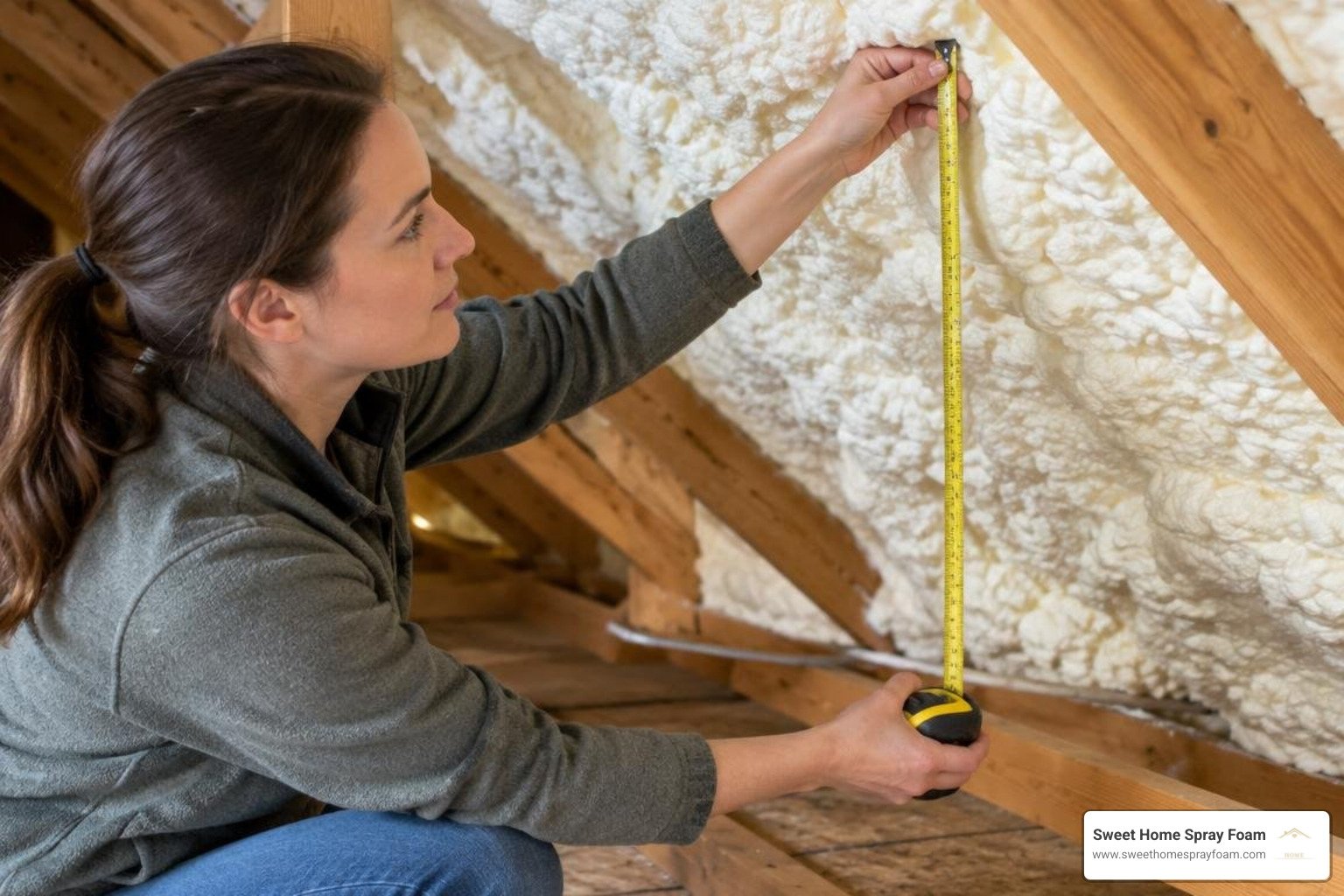
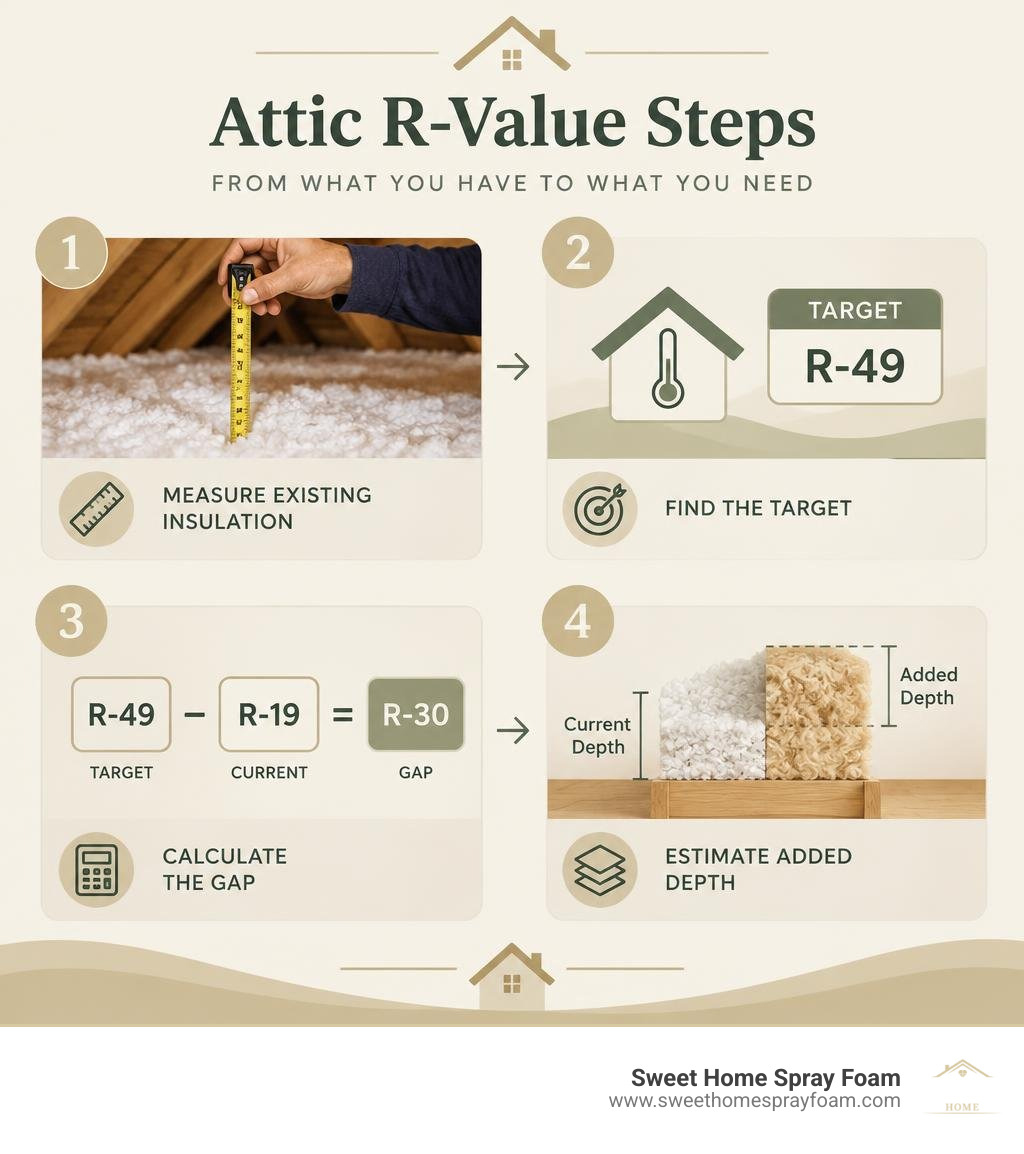
An attic insulation R-value calculator helps you find the gap between what you have and what you need. Measure your attic’s insulation depth, use its material rating to estimate its current R-value, and check the target for your Virginia climate zone and local code. Subtract your current R-value from that target. Then divide the gap by the manufacturer-rated R-value per inch of the insulation you plan to add.
For example, an attic at R-19 needs 30 more R-value points to reach R-49. That estimate is a starting point, not an installation plan: air leaks, moisture, and where the insulation sits all matter. If high bills and uneven temperatures brought you here, measure first, then check the attic before choosing a thickness.
How an Attic Insulation R-Value Calculator Works
At its core, an attic insulation R-value calculator measures thermal resistance—the ability of a material to resist conductive heat flow. The higher the R-value, the better the thermal performance. In building science, R-value is mathematically defined by dividing material thickness by its thermal conductivity.
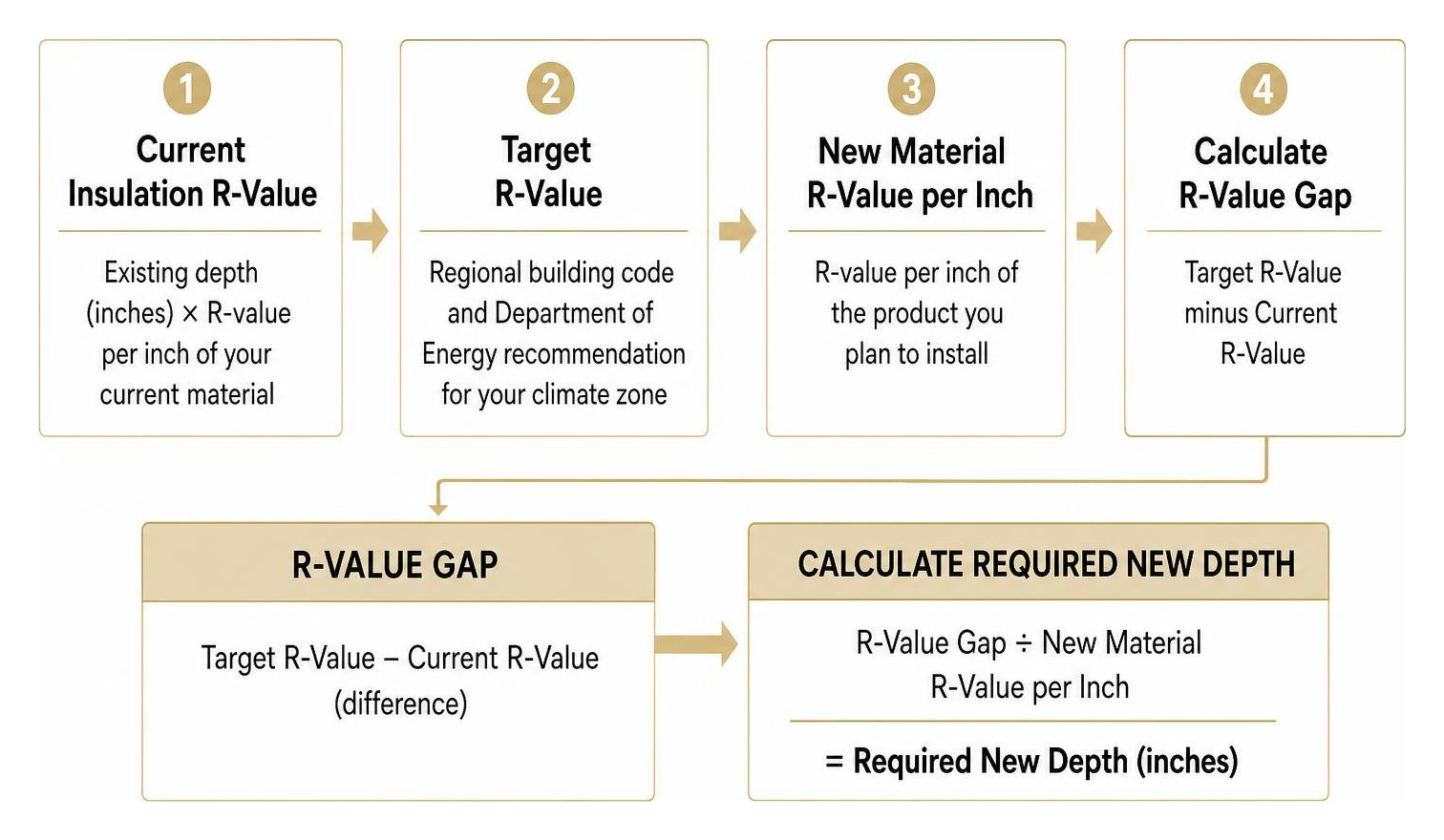
When you use our comprehensive attic insulation guide for 2026, you will discover that calculating your insulation needs requires four key variables:
- Attic Square Footage: The total floor area of your attic footprint (length × width).
- Current Insulation R-Value: The existing depth in inches multiplied by the R-value per inch of your current material.
- Target R-Value: The regional building code and Department of Energy recommendation for your specific climate zone.
- New Material R-Value per Inch: The thermal rating of the product you plan to install.
By taking the difference between your target R-value and your current R-value (known as the R-value gap), you can determine the exact depth of new material required. For deeper technical insights on heat dynamics, check out High-R Attics | Building Science Education to see how properly designed thermal boundaries protect your living space.
Climate Zone Recommendations and Target R-Values
The International Energy Conservation Code (2021 IECC) and the U.S. Department of Energy (DOE) establish clear baseline requirements across different geographical regions. In Virginia communities like Richmond, Charlottesville, Lynchburg, and Roanoke, we fall into Climate Zone 4.
For uninsulated attics, modern energy standards recommend building assemblies between R-49 and R-60. Meeting these targets prevents your conditioned air from escaping through your ceiling during cold winters and keeps intense summer attic heat from radiating downward.
When evaluating regional climate considerations for attic insulation in Richmond VA, hitting the recommended R-value can reduce heating and cooling costs by 20% to 40%. An under-insulated attic accounts for 25% to 30% of an average home's total heat loss.
| Climate Zone | Geographic Region | IECC 2021 Minimum | DOE / ENERGY STAR Recommendation |
|---|---|---|---|
| Zone 1 | Deep South, South FL, Hawaii | R-30 | R-30 to R-49 |
| Zone 2 | Gulf Coast, Southern TX & GA | R-30 | R-38 to R-49 |
| Zone 3 | Mid-South, Lower Atlantic | R-49 | R-49 |
| Zone 4 | Mid-Atlantic (VA), Central US | R-49 | R-49 to R-60 |
| Zone 5 | Northern Midwest, Mid-New England | R-49 | R-60 |
| Zone 6 | Northern US, High Elevations | R-60 | R-60 |
| Zone 7–8 | Extreme Cold, Alaska, Northern Rockies | R-60 | R-60 |
Assessing Existing Insulation Depth and R-Value
Before running calculations, head into your attic with a tape measure or ruler. Measure the depth of the insulation at three or four separate spots across the floor to account for uneven settling or disturbances.
Take note of your joist framing. When evaluating framing between attic floor joists, standard 2x6 floor joists are 5.5 inches deep, while 2x8 joists are 7.25 inches deep. If you can see the wooden tops of your floor joists, your attic is under-insulated (typically below R-19).
To calculate your starting point, multiply your measured depth by the appropriate material rating:
- Old Blown Fiberglass: ~R-2.2 to R-2.5 per inch
- Fiberglass Batts: ~R-3.0 to R-3.4 per inch
- Blown Cellulose: ~R-3.2 to R-3.8 per inch (averages R-3.5)
- Closed-Cell Spray Foam: ~R-6.0 to R-7.0 per inch (averages R-6.5)
- Open-Cell Spray Foam: ~R-3.6 to R-3.8 per inch
If your attic has 4 inches of old loose fiberglass, your current R-value is approximately R-10 (4 inches × 2.5). To hit a Zone 4 target of R-49, you have an R-value gap of 39.
Step-by-Step Guide to Calculating Insulation Depth
Calculating the exact material needed for your home requires three simple steps:
- Calculate the R-Value Gap: Subtract your existing R-value from your target R-value.
R-Value Gap = Target R-Value - Existing R-Value - Determine Added Depth Needed: Divide the gap by the R-value per inch of your chosen insulation material.
Added Depth (Inches) = R-Value Gap / Material R-Value per Inch - Calculate Total Volume & Packaging: Multiply the added depth (in feet) by your attic square footage to get total cubic feet of insulation.
For a 1,500 sq ft attic upgrading from R-19 to R-49 (a 30-point gap):
- Using loose-fill cellulose (R-3.5/inch): You need 8.6 inches of added material.
- Using loose-fill fiberglass (R-2.5/inch): You need 12.0 inches of added material.
If you are exploring loose-fill options, you can cross-reference your measurements using a digital Attic Insulation Calculator: Bags, Inches & R-Value or the tools available on the Blown-In Insulation Calculator.
Using the Attic Insulation R-Value Calculator for Spray Foam
Spray foam delivers high thermal resistance per inch while simultaneously establishing a continuous air seal.
When calculating spray foam depth:
- Closed-Cell Spray Foam: At R-6.5 per inch, achieving R-49 requires only 7.5 inches of material. Closed-cell foam provides superior structural rigidity and acts as an impermeable Class II vapor retarder.
- Open-Cell Spray Foam: At R-3.7 per inch, achieving R-49 requires approximately 13.2 inches of material. Open-cell foam expands to fill crevices and excels at sound dampening.
Because spray foam adheres directly to the roof deck or attic floor, it seals bypasses that traditional loose-fill blown insulations allow air to pass through.
Thickness Formula Breakdown
To convert thickness into material quantities, calculate total volume:
- Convert depth to feet:
Added Depth (inches) / 12 = Depth (feet) - Calculate volume:
Attic Square Footage × Depth (feet) = Required Volume (cubic feet) - Factor in settling and coverage: Loose-fill cellulose settles 15% to 20% over its first few years. Professional installers always blow extra thickness upfront to guarantee long-term R-value performance. Always factor a 10% material buffer for waste and framing variances.
Critical Preparation and Installation Steps
Calculating thickness is only half the battle. Blowing insulation directly over an unsealed attic floor is like wearing a thick wool sweater on a windy winter day—without a windbreaker, drafts cut right through.

Before installing new insulation, focus on preparing the surface for the best insulation for attic floors. If your existing material is degraded by rodent droppings, mold, or moisture, consider clearing old contaminated material and estimating attic cleanup and insulation cost before adding fresh layers.
Air Sealing Before Insulating: The Foundation for High R-Value
The Department of Energy estimates that air leakage accounts for 25% to 40% of heating and cooling energy loss in typical homes. Warm air rises through natural convection (the stack effect) and escapes through hidden openings in your attic floor.
Field studies show that air-sealing the attic floor before adding insulation delivers 20% to 40% better whole-house energy savings compared to adding insulation alone.
Priority air-sealing zones include:
- Wall top plates (the framing directly above your drywall partitions)
- Recessed can lighting fixtures (use fire-rated covers or IC-rated airtight housings)
- Electrical and plumbing penetrations
- HVAC duct boots and chases
- Attic access hatches and pull-down stairs
Applying spray foam across these gaps creates an airtight thermal envelope, preventing conditioned air from escaping into the unconditioned attic.
Maintaining Attic Ventilation and Soffit Clearances
In a traditional vented attic assembly, air flows in through the soffit vents at the eaves and exits through the ridge vents at the peak.
If loose-fill or batt insulation covers your soffit vents, moisture becomes trapped inside the attic space. This can lead to mold growth, rotted roof decking, and winter ice dams. Always install rigid plastic or foam rafter baffles (vent chutes) at every rafter bay before adding insulation to maintain clear airflow from the eaves to the ridge.
Costs, Energy Savings, and Payback Timeline
Upgrading attic insulation delivers one of the highest returns on investment (ROI) of any home improvement. Upgrading a poorly insulated attic (R-11 to R-19) up to modern R-49 standards in Virginia saves homeowners an average of $200 to $600 per year on utility bills.
When understanding your total attic insulation cost, project estimates vary by installation type:
- DIY Loose-Fill Cellulose: For a 1,000 sq ft attic at R-49, materials run $800 to $1,200 (about 71 bags at $12–$15 per bag).
- Professional Loose-Fill Installation: Runs approximately $1.50 to $2.50 per sq ft ($1,500 to $2,500 total).
- High-Performance Spray Foam Installation: Professional spray foam applications typically pay for themselves within 3 to 7 years through reduced HVAC runtime and extended equipment life.
Incentives and Rebates (2026)
- Federal Section 25C Tax Credit: The Inflation Reduction Act provides a federal tax credit covering 30% of insulation and air-sealing material costs, up to a maximum of $1,200 per year through 2032.
- Local Utility Rebates: Electric and gas utilities across Virginia often offer energy efficiency rebates ranging from $200 to $800 for verified attic insulation and air sealing retrofits.
Avoiding Costly Mistakes with an Attic Insulation R-Value Calculator
When using an attic insulation calculator, watch out for these frequent oversights:
- Forgetting Loose-Fill Settling: Cellulose settles by 15% to 20%. If you need 14 inches for R-49, install 16 to 17 inches initially.
- Compressing Batt Insulation: Jamming an R-30 batt into a 2x4 cavity crushes air pockets and slashes its effective R-value by more than 50%.
- Covering Soffit Vents: Never blow insulation flush against the roof deck eaves without installing baffles first.
- Skipping the Air Seal: Insulation resists heat conduction, not air leakage. Always air-seal gaps before adding blown material.
- Ignoring Moisture Leaks: Never insulate over damp framing, active roof leaks, or mold. Address underlying moisture issues first.
Frequently Asked Questions About Attic Insulation R-Values
How many inches of spray foam equals R-49?
Closed-cell spray foam averages an R-value of 6.5 per inch, requiring roughly 7.5 inches to reach R-49. Open-cell spray foam averages R-3.7 per inch, requiring roughly 13.2 inches of depth to achieve R-49.
Can I add spray foam over existing insulation?
Spray foam requires direct adhesion to clean framing, roof decking, or ceiling drywall to establish an effective air and thermal barrier. Existing loose-fill cellulose or fiberglass batts must be removed before spraying foam onto the attic floor or roof deck.
Does attic insulation qualify for federal tax credits in 2026?
Yes. Under the Section 25C Energy Efficient Home Improvement Credit, homeowners can claim a federal tax credit equal to 30% of insulation and air-sealing material costs, capped at $1,200 annually.
Conclusion
Determining your attic's insulation needs is a simple calculation: find your existing R-value, compare it against the R-49 to R-60 standards for Virginia, and close the gap with properly installed, air-sealed insulation. Sealing air leaks and choosing high-performance materials prevents drafty rooms, balances indoor temperatures year-round, and lowers your monthly power bills.
If you are ready to eliminate high energy costs and improve your home's comfort across Richmond, Charlottesville, Lynchburg, or Roanoke, contact our team at Sweet Home Spray Foam today for a detailed assessment and upfront pricing.